
 Scoop has an Ethical Paywall


Canterbury Goes Back-to-Back In ASB’s Latest Regional Economic Scoreboard

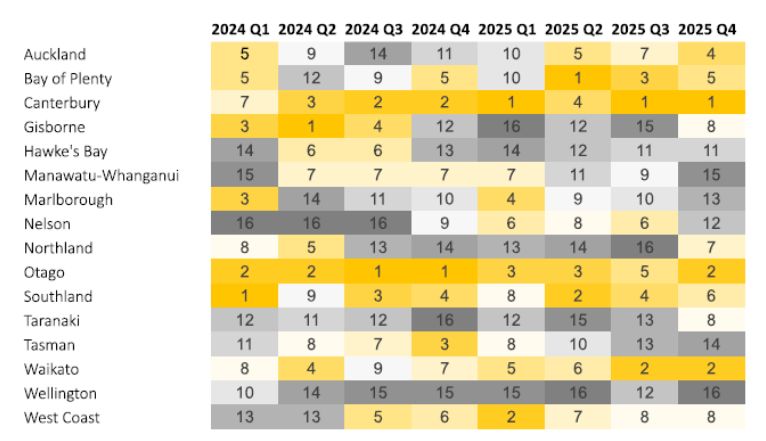
- South Island continues to hold strong with Canterbury outperforming the rest of the country
- Otago and Waikato coming in second place equal
- Auckland shows promising signs of improvement, jumps to fourth place
- Wellington remains under pressure, finishing last place
Canterbury continues to shine in ASB’s Regional Economic Scoreboard, finishing 2025 as New Zealand’s strongest-performing region as signs of economic recovery broaden across the country.
ASB’s Regional Economic Scoreboard shows Canterbury secured its third quarterly win of the year, outperforming the country across nearly every key measure the bank tracks including employment, retail spending, housing activity and population growth.
ASB Chief Economist Nick Tuffley says the South Island continues to lead New Zealand’s multispeed recovery.
“Canterbury has delivered backtoback wins to close out the year, supported by strong dairy incomes, steady jobs growth, resilient consumer spending and the recovery of the tourism sector. The region enters 2026 in a very strong position,” says Nick.
Otago and Waikato tied for second place, with Otago buoyed by a strong tourism recovery and Waikato benefiting from its robust primary sector and improving labour market conditions. We expect the incoming Fonterra capital return to be a further boost for our Dairy farming regions via more spending and investment.
Auckland climbed to fourth place, recording improvements in retail spending, construction activity and consumer confidence, although labour market conditions in the city remain subdued.
“Seeing Auckland continue to improve is an important signal that the economic upswing is widening beyond the regions that led earlier in the cycle,” says Nick.
At the other end of the rankings, Wellington finished last, reflecting ongoing weakness in the housing market, construction activity and discretionary spending, despite relatively strong employment growth.
“Looking ahead, Wellington’s economy is forecast to recover, supported by low interest rates. Nevertheless, ongoing and emerging challenges may temper the pace of that recovery.”
Nationally, the economy showed signs of growth toward the end of 2025. Retail spending lifted strongly across most regions, supported by lower interest rates, while employment indicators showed early signs of stabilisation. However, ASB economists caution that global uncertainty remains a key risk.
“Conflict in the Middle East presents fresh headwinds, particularly through higher energy costs and inflation risks. The situation and extent of any impact to growth and inflation is highly uncertain and will depend on how long the conflict goes on for,” says Nick.
Results in a snapshot
ASB Bank
Helping you get one step ahead.
In 1847, ASB opened as the Auckland Savings Bank with the pledge: 'to serve the community; to grow and to help Kiwis grow'. And that is very much what ASB is about today.
ASB is a leading provider of integrated financial services in New Zealand including retail, business and rural banking, funds management and insurance.
ASB strives to consistently provide its customers with outstanding service and innovative financial solutions. They're dedicated to providing simple financial products that allow their customers to bank with them how and when they want.
We all have our own ways to measure progress, and our own stories about the things that matter to us. Whatever way you choose to measure progress, and whatever your goals, ASB is there to help you get one step ahead.
 Bill Bennett: Fixed Voice Rules Head For Deregulation
 UN Department of Global Communications: United Nations Proposes New Global Dashboard To Measure Progress Beyond GDP
 Banking Ombudsman Scheme: Fraud Check Delays Well Worth The Inconvenience, Says Banking Ombudsman
 Asia Pacific AML: NZ’s Financial Crime Gap - Beyond The 'Number 8 Wire' Mentality
 Westpac New Zealand: Kiwi Households Adapting Despite Widespread Cost Pressure Concerns, Westpac Survey Shows
 University of Auckland: Kids’ Screen Use Linked To Long-Term Deficits In Self-Control And Attention


