
 Scoop has an Ethical Paywall


Commercial Cleaning Firms Face Mixed EOFY: Budget Cuts VS Last-Minute Client Spending
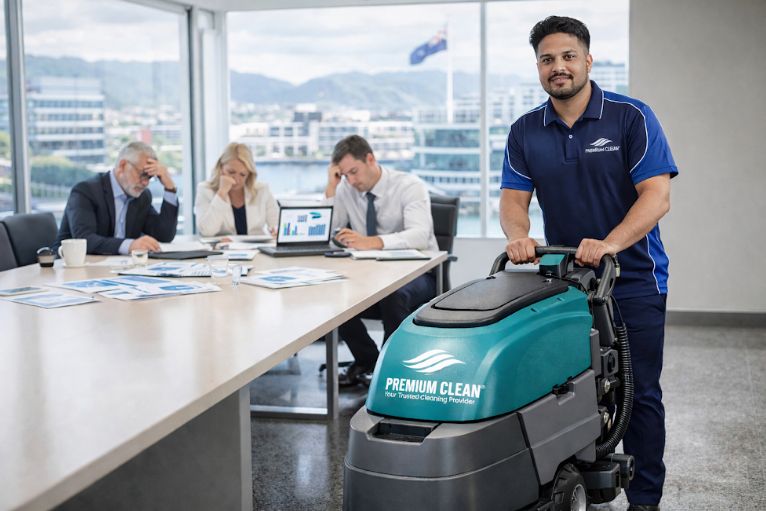
Industry leaders warn that end-of-financial-year cash flow pressure and late-breaking client demand are arriving simultaneously — and only prepared operators will capture both.
New Zealand's commercial cleaning sector is entering its most financially complex period of the year, with the end of the financial year (EOFY) simultaneously triggering client-side budget freezes and a last-minute surge in high-value service requests. Industry operators report that navigating both forces in the same six-week window is separating well-prepared businesses from those caught off guard.
Corporate Budget Freezes Drive Payment Delays
With the financial year-end approaching, facilities and finance teams across New Zealand's corporate sector are intensifying their review of service contracts, with commercial cleaning among the first categories flagged for deferral or reduction. Non-essential cleaning services are being pushed into the new financial year as clients attempt to tighten expenditure ahead of their own reporting deadlines.
The downstream effect on cleaning companies is measurable. Operators across the sector are reporting payment cycles 15 to 20 per cent slower than standard terms during the final weeks of the financial year, as commercial clients hold cash to manage their own EOFY balance sheet positions. For cleaning businesses carrying payroll obligations, consumables costs, and supplier commitments, the timing creates acute short-term pressure.
The problem is not unique to any one company. It is a structural feature of the industry's relationship with corporate billing cycles, and cleaning operators that do not plan for this pattern risk entering the new financial year undercapitalised.
Last-Minute Budget Spending Creates Parallel Surge in Demand
At the same time, a countervailing trend is gaining momentum. As finance departments approach the financial year-end with unspent facilities budgets, commercial clients are actively seeking approved services they can deploy before the books close. Offices, warehouses, and retail sites across New Zealand are commissioning end-of-year deep cleans, external building washes, carpet and hard-floor restoration, and full sanitation services, often with short lead times.
These "balance sheet cleans," as they are increasingly known within the industry, represent a genuine revenue opportunity for cleaning companies positioned to respond quickly with defined, fixed-price service packages.
Sam Bandhari, Managing Director of Premium Clean, says the pattern is now reliable enough to build a commercial strategy around.
"Every year we see the same dynamic play out. Clients go quiet, then, by the final weeks of the financial year, the calls start coming in from facilities managers who have a budget to spend and a hard deadline. The businesses that benefit are the ones that have their EOFY packages ready to go before that window opens — not the ones scrambling to put a quote together when the client is already on the phone."
Bandhari advises that commercial cleaning operators should have fixed-price EOFY offerings confirmed and available for client discussion by mid-May to capture this demand effectively.
Tax and Compliance Considerations Offer Additional Upside for Operators
Beyond the client-facing opportunity, EOFY offers internal financial-planning advantages for cleaning companies. Under current Inland Revenue provisions for small and medium businesses, operators may be eligible to write off qualifying asset purchases made before the financial year closes, including commercial floor scrubbers, ride-on cleaning machines, eco-certified equipment, and fleet vehicle upgrades, immediately.
For companies already generating revenue from late-EOFY service contracts, reinvesting a portion of that income into eligible capital purchases before year-end is a strategy that simultaneously upgrades operational capacity and reduces taxable income in the current period.
"The smarter operators use the revenue spike at year-end as a trigger to do their own financial housekeeping," said Bandhari. "If you've been considering new equipment, EOFY is often the most tax-efficient time to act. You're doing for your own business exactly what your clients are doing for theirs."
Cleaning companies are advised to consult their accountant or financial advisor to confirm eligibility for asset write-offs and the applicable thresholds under current Inland Revenue guidelines.
Preparation Is the Competitive Differentiator
With EOFY pressures escalating on both sides of the commercial cleaning relationship, Premium Clean is urging operators across the sector to take a proactive approach to the year-end period rather than a reactive one.
Key recommendations include accelerating invoicing timelines to increase the likelihood of payment before year-end, offering structured EOFY service packages that provide corporate clients with a fast, approvable spending option, maintaining open communication with clients about payment terms, and strategically using any EOFY revenue to fund tax-deductible capital investment before the financial year closes.
Commercial clients seeking to lock in EOFY cleaning packages are advised to engage their service provider before 31 May to ensure scheduling availability and allow adequate time for invoicing within the current financial year.
About Premium Clean
Premium Clean is New Zealand's trusted provider of ISO-certified commercial and residential cleaning services, operating nationwide across Auckland, Wellington, Christchurch, Hamilton, Tauranga, Dunedin, Hastings, Napier, Nelson, Palmerston North, and Rotorua. Founded in 2015 and led by Managing Director Sam Bandhari, Premium Clean holds ISO, IICRC, and Prequal Health and Safety certifications and maintains a 100% satisfaction guarantee across all services. The company serves corporate, retail, industrial, hospitality, and government clients throughout Aotearoa New Zealand.
 UN Department of Global Communications: United Nations Proposes New Global Dashboard To Measure Progress Beyond GDP
 Banking Ombudsman Scheme: Fraud Check Delays Well Worth The Inconvenience, Says Banking Ombudsman
 Asia Pacific AML: NZ’s Financial Crime Gap - Beyond The 'Number 8 Wire' Mentality
 Westpac New Zealand: Kiwi Households Adapting Despite Widespread Cost Pressure Concerns, Westpac Survey Shows
 University of Auckland: Kids’ Screen Use Linked To Long-Term Deficits In Self-Control And Attention
 University of Auckland: Research To Address Equity In STEM For Māori, Pacific And Female Students


