
 Scoop has an Ethical Paywall


Most Business Owners Continue To Be In Survival Mode, Not Helped By The Current Situation In The Middle East
The topic
The impasse over the situation in Iran and the crippling effect happening in Aotearoa New Zealand, with both households and businesses directly impacted (with little government relief), adds salt to an economic wound that has been festering for some time. Economists are reporting that very soon inflation is likely to be well in excess of the RBNZ’s top-end target of 3%.
As a reality check for those living in the capital city, The Post-$’s Rob Stock reported (on Monday 7 April 2026), that a net 1,578 Wellington firms closed between November 2023 and February this year, while a net 12,000-plus firms opened in Auckland, the Waikato and Christchurch.
The survey
Last September, when we completed our State of Business Poll, almost two-thirds of respondents (62%) described the current economic situation in Aotearoa New Zealand as ‘bad’ or ‘very bad’; significantly more than in June 2025 (55%) and in March 2025 (53%).
Given recent worldwide developments, we decided to complete another of these polls. For this new poll, a sample of n=433 business owners and senior managers were interviewed online between 24 March and 2 April 2026. This sample is nationally representative in terms of business type and business size. Respondents were recontacted by agreement after having participated in previous business surveys. As usual, we asked them questions about:
- The current economic conditions and how these compared with the situation in 2023-2024 and 2024-2025.
- How they saw these conditions changing, if at all, in the immediate future.
- What their plans were for their business (i.e., retrenchment or development).
- Their business expectations for the current year (i.e. sales, revenue, profitability and costs).
- Whether they would be investing in their business, and in which areas they planned to invest.
This poll also included special questioning on the impact of the current situation in the Middle East.
Key findings
The following are the key findings from this poll:
- In three separate polls last year, significantly more respondents were identified as being pessimistic than optimistic with their trading conditions. In this poll, this pattern not only continues, but has become worse.
A record 42% of respondents stated they had ‘hardly ever’ felt ‘hopeful and optimistic’ in the last 2 weeks, or ‘not at all’. This compares with 22% who said they had felt ‘hopeful and optimistic’ ‘all the time’, or ‘many times’.
- All types of business owners, regardless of their industry category, business size, or region, are feeling stressed.
- Against this background:
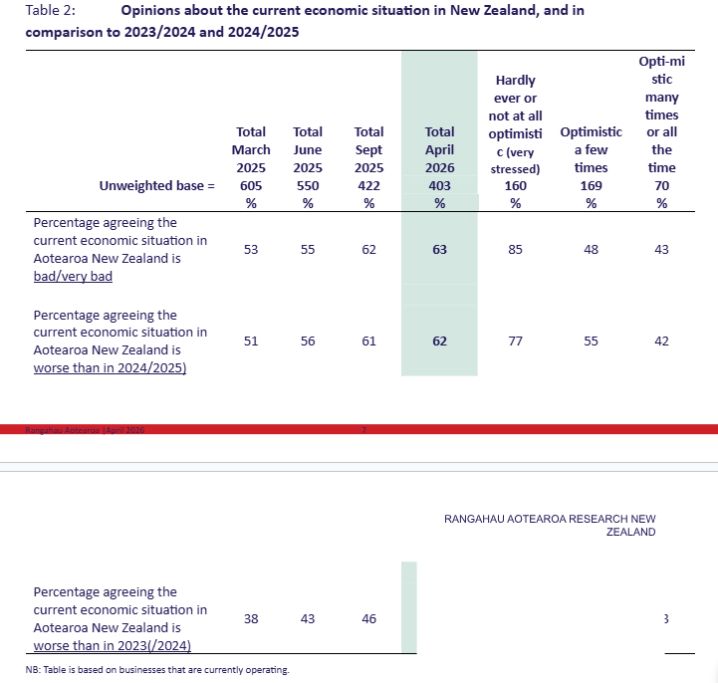
- 63% of respondents also described the current economic situation in Aotearoa New Zealand as ‘bad’ or ‘very bad’. This is a similar percentage as in September 2025 (62%), but much higher than the percentages in March (53%) and June (55%).
- As was the situation in March, June and September last year, around one-quarter predicted decreases of ‘20% or more’ in their revenue in the next 12 months (21%) and profitability (24%), combined with an increase of ‘20% or more’ in their costs (31%).
- As a result, most respondents reported being focused on maintaining their business and keeping it roughly the same size (52%). This was also the case in March, June and September 2025.
However, 14% saw themselves downsizing, while 2% were planning to close down (16% overall). In comparison, 31% reported being in expansion and development mode.
- Almost two-thirds of respondents (61%) said they were not planning any investment in their business in the next 12 months. Amongst those who are planning to invest, most investment is likely to occur in ‘marketing, promotions & sales’ (20%), ‘new IT/technology to help the business run more efficiently internally’ (18%) and/or ‘new IT/technology to help the business run more efficiently externally’ (18%).
- Compounding the above is the impact of the conflict in the Middle East. One-in-every two respondents stated they were concerned with the impact of the conflict in the Middle East on their business. Specifically, one-in-every-two said they were either ‘very concerned’ (28%) or ‘extremely concerned’ (21%); 49% in total.
Compared with the percentage who were concerned with the impact on their business, a much greater percentage of respondents (71%) stated they were concerned about the impact of the conflict on the economy in general. In fact, 40% said they were ‘very concerned’ and 31% said they were ‘extremely concerned’.
Comment
“In our September 2025 State of the Business poll, much of the feedback related to the fact that most business owners were looking for greater certainty before they looked to grow, develop and invest in their business. While the domestic economy has continued to splutter in the interim, the conflict in the Middle East has put a further spanner in the works.”
High-level findings – New Zealand’s business owners continue to experience high levels of stress
- Respondents were asked to comment on how many times they had felt ‘hopeful and optimistic’ in the last 2 weeks.
Last year, in three separate polls three months apart, significantly more respondents stated they had ‘hardly ever’ felt hopeful and optimistic, or ‘not at all’, compared with the percentage who said they had felt ‘hopeful and optimistic’ ‘all the time’, or ‘many times’ (refer to Figure 1).
In September, for example, just over one-third (35%) said they had ‘hardly ever’ felt hopeful and optimistic, or ‘not at all’. In contrast, fewer (22%) said they had felt ‘hopeful and optimistic’ ‘all the time’, or ‘many times’.
In this poll, this pattern not only continues, but has become worse. A record 42% of respondents stated they had ‘hardly ever’ felt ‘hopeful and optimistic’ in the last 2 weeks, or ‘not at all’. They are referred to in this report as, very stressed business owners.
When we add the respondents who stated they had felt hopeful or optimistic only a few times in the last two weeks, we can say that 83% of respondents were experiencing some degree of stress.
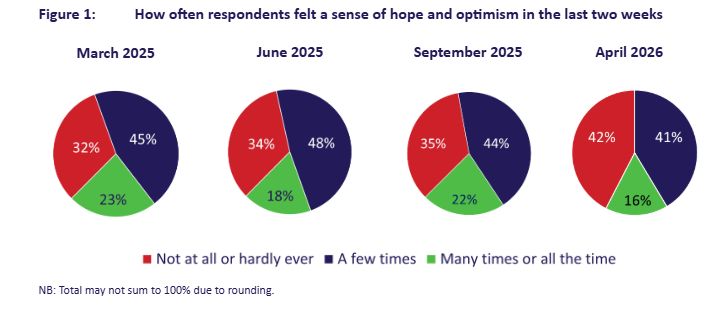
NB: Total may not sum to 100% due to rounding.
Some examples of how respondents described their current situation:
“Global uncertainty hits hard, prolonging our "recovery". The government response to fuel crisis and impacts of US actions in the Middle East has not given anyone hope for improvement.” (Other industries, 2 to 5 staff)
“We experienced a noticeable improvement in market conditions, with a greater number of job and project opportunities becoming available. Small to medium government sector projects, in particular, contributed to a sense of optimism and growth. More recently, however, this momentum appears to have weakened, and the pace of new opportunities has begun to slow.” (Construction, 50 to 99 staff)
“I think there are so many disruptive factors coming into play now that the usual hope of 'weathering the storm' and expecting it to pass is unlikely to pay off. With the existing strains brought about by climate change, the impacts of severe weather events on infrastructure and means of production, increasing energy costs and now this ridiculous war, we need to be thinking about how we are going to adapt to the big changes and harder times coming.” (Manufacturing, Sole trader)
2. As we have seen previously, the high levels of stress being experienced by New Zealand businesses are being experienced by all types of business owners and managers, regardless of their industry category, business size, or region.
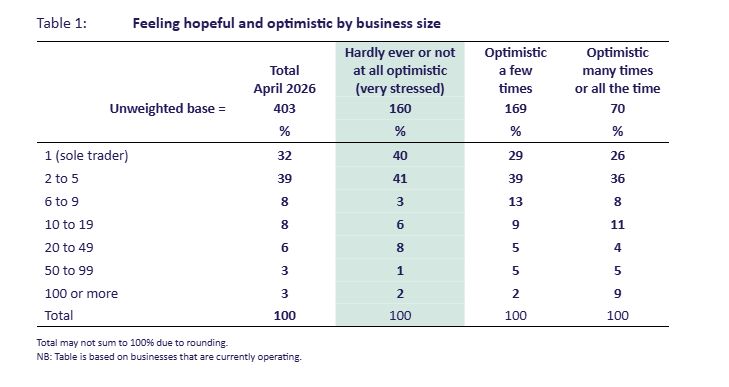
However, relatively-speaking, sole traders appear to be the most stressed. Table 1 shows they made up one-third of those interviewed (32%), but 40% of the group that reported they had ‘hardly ever’ felt hopeful and optimistic, or ‘not at all’ in the last 2 weeks.
In comparison, a significantly lower percentage of sole traders (26%) reported being optimistic ‘many times’ or ‘all of the time’ in the last two weeks.
Some examples of how respondents described their current situation:
“The Middle East situation unfortunately gives the present government another excuse as to why they have underperformed and been economically lazy. Possibly hamstrung by smaller coalition partners, we can only hope that the upcoming election tempts them into a more positive approach.” (Rental, hiring, etc., 6 to 9 staff)
“There has been reported that there is a sense of optimism for the future which is not realistic with the falling production and industrial base in NZ. Investment in many industries has not been forthcoming, and corporate business is being driven by shareholder returns at the cost of maintenance of existing physical assets or investment in new businesses.” (Manufacturing, 20 to 49 staff)
“It is virtually impossible to plan forward at present due to the complete upheaval with the Middle East war. Things were okay with some slight optimism, but now that is totally wiped out, and we are concerned about whether we can continue to keep all staff employed in the medium-term.” (Retail, etc., 10 to 19 staff)
Almost two-thirds of respondents described the current economic situation in Aotearoa New Zealand as ‘bad/very bad’, especially those who are stressed
- Last year, in September, almost two-thirds of all respondents (62%) described the then current economic situation in Aotearoa New Zealand as ‘bad’ or ‘very bad’ (Table 2). This was significantly more than the percentage in March (53%) and June 2025 (55%).
In this poll, a similar percentage as in September (63%) described the current economic situation in Aotearoa New Zealand as ‘bad’ or ‘very bad’.
- Not surprisingly, a significantly higher percentage of the very stressed business owners (42%) described the current economic situation in Aotearoa New Zealand as ‘bad’ or ‘very bad’ and far worse in comparison to how they described the situation in 2023/2024 (72%) and 2024/2025 (77%).
- Furthermore, despite their optimism, even almost one-in-every two respondents who said they had been optimistic ‘many times’ or ‘most of the time’ in the last two weeks, described the current economic situation as ‘bad’ or ‘very bad’ (43%).
 Bill Bennett: Fixed Voice Rules Head For Deregulation
 UN Department of Global Communications: United Nations Proposes New Global Dashboard To Measure Progress Beyond GDP
 Banking Ombudsman Scheme: Fraud Check Delays Well Worth The Inconvenience, Says Banking Ombudsman
 Asia Pacific AML: NZ’s Financial Crime Gap - Beyond The 'Number 8 Wire' Mentality
 Westpac New Zealand: Kiwi Households Adapting Despite Widespread Cost Pressure Concerns, Westpac Survey Shows
 University of Auckland: Kids’ Screen Use Linked To Long-Term Deficits In Self-Control And Attention


