
 Scoop has an Ethical Paywall


SEEK NZ Employment Report - March
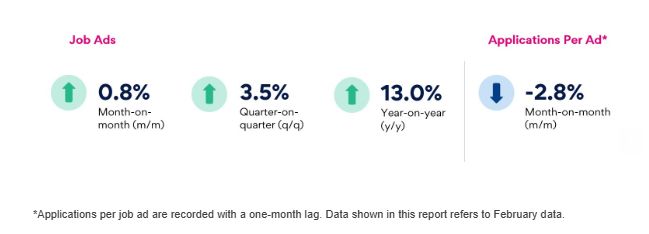
According to the latest SEEK NZ Employment Report, job ads continued to grow, rising 0.8% m/m and 13.0% y/y, highlighting a sustained improvement through the early part of 2026. Applications per job ad fell 2.8% from the month prior, the sixth consecutive drop, as candidate activity continues to decline from the peak levels set in August 2025.
AI references in job ads have risen 143.5% since March 2025, and are now over five times as high as they were in 2019. However, AI references currently appear in only 2.9% of job ads.
The South Island continues to lead the country for strong annual growth, but all regions in the North are now higher y/y and all but Auckland rose m/m.
Construction remains the engine of annual growth, up 36.0% y/y despite remaining steady m/m. Trades & Services and Manufacturing, Transport & Logistics each grew m/m (1.8% and 1.9% respectively) and y/y (22.5% each), highlighting robust demand for roles in these infrastructure-based industries.
AI Insights:
- References to AI-related skills within job ads have more than doubled y/y (143.5%).
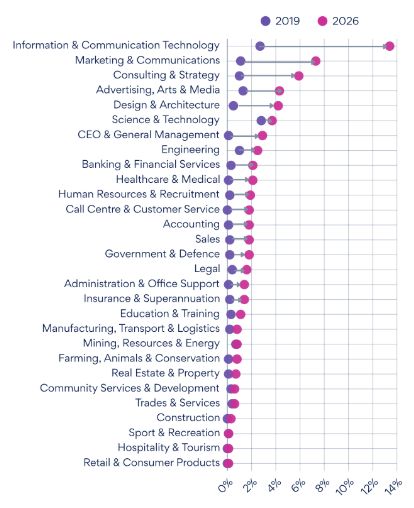
- AI references are most common in job ads within Information & Communication Technology, followed by Marketing & Communications.
National Insights:
- Job ads continued to grow, rising 0.8% m/m and 13.0% y/y.
- Applications per job ad continue to fall, down 2.8% m/m.
Region Insights:
- The strongest m/m growth was recorded in Taranaki (2.1%), as Southland recorded the South Island’s fastest rise (1.9%).
- Auckland declined m/m (0.1%) but remains higher y/y (5.5%) while Wellington was broadly flat m/m (0.1%) but grew y/y (11.7%).
Industry Insights:
- Construction recorded the largest y/y rise (36.0%) but was flat m/m (0.0%).
- Information & Communication Technology fell slightly m/m (-0.1%) but rose y/y (+10.1%).
- Trades & Services and Manufacturing, Transport & Logistics both saw monthly rises of 1.8% and 1.9% respectively.
AI Insights
Demand for AI skills has grown exponentially over the past few years. AI references in job ads have risen 143.5% since March 2025, and are now over five times as high as they were in 2019. However, AI references currently appear in only 2.9% of job ads.
AI references are most common in ads for roles in Information & Communication Technology, where 13.4% of job ads mention AI, followed by Marketing & Communications (7.3%) and Consulting & Strategy (5.9%).
Figure 1: The SEEK AI Gauge – Measure of job ads that include AI-related keywords
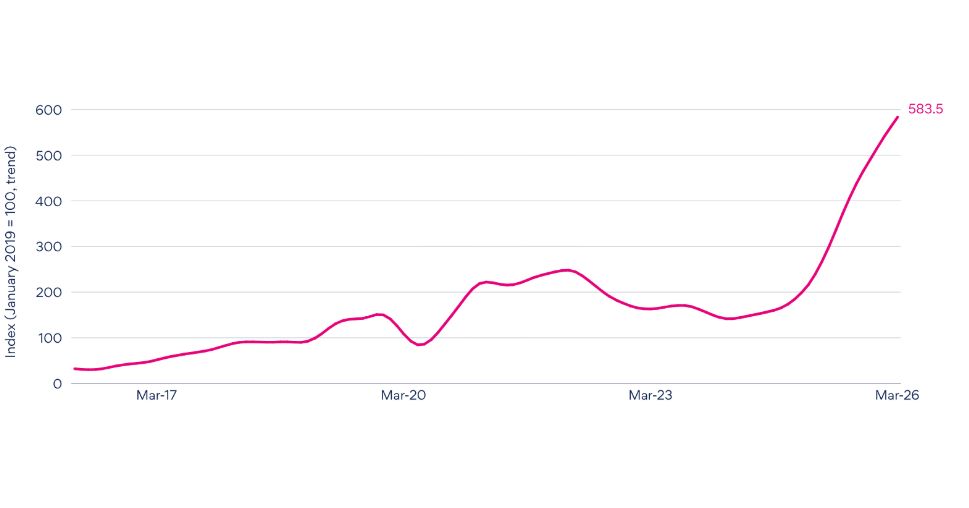
Figure 2: AI-mentions in jobs ads, shown as a share of total job ads by classification 2019 to 2026
Rob Clark, SEEK NZ Country Manager, says:
“Positive momentum in the South
Island remains a defining feature of the 2026 job market to
date.
Southland and Otago continue to grow
steadily with rising demand in the Construction and
Industrial sectors, but growth broadened in the North in
March as well, with Taranaki and Waikato driving up the
monthly volumes.
“At the industry level, Construction continues to set the pace with annual growth of 36.0%. Trades & Services and Manufacturing, Transport & Logistics each posted solid annual and monthly gains. These figures reflect an economy where infrastructure, primary industries and operational roles are driving real hiring demand.
“Overall, the March data reinforces what we've been seeing build since late 2025 – a broad-based, durable recovery anchored in goods-producing industries, essential services, and infrastructure-related hiring, with encouraging signs of the North Island catching up to the South Island's strong run.”
 Priority one: Regional Deal Strengthens Confidence In The Western Bay Of Plenty
 REINZ: Buyer Activity Softens As Living Costs Remain A Consideration Across Key Regions
 Better Taxes for a Better Future: Tax Policy Welcome Contribution, But Missed Opportunity To Tackle Wealth Inequality
 Google Threat Intelligence Group - GTIG: Google Threat Report Warns AI-Driven Cyber Operations Are Scaling Across Global Threat Landscape
 Commerce Commission: Baseline Research Report On The State Of Competition In New Zealand
 University of Auckland: Junk Food Designed To Make Us Eat More, Study Finds


