
 Scoop has an Ethical Paywall


Credit Score Gaps And Their Impact On Mortgage Pricing

A score from a single credit bureau alone is not enough to determine the viability and outcome of a mortgage application. While there are widely recognized benchmarks, such as a score of 700, that are often associated with approval, better interest rates and other favorable outcomes, these numbers do not tell the full story. Individual credit profiles can look very different from borrower to borrower depending on where the data comes from. Because of this, relying on one fixed score, standard or cutoff tends to oversimplify a realistically complex process. Lenders must rely instead on a more comprehensive method to understand financial positioning before offering loans and mortgage plans.
The tri-merge credit report method is beginning to become the best way to decipher the creditworthiness of a borrower. Instead of pulling information from one or two bureaus, the tri-merge report compiles data from all three major bureaus to get a better snapshot of the borrower’s financial standing. This approach creates a more balanced and dependable view of an applicant. Research shows that single-bureau or even bi-merge reports can leave out important details or cause inconsistencies that may skew the assessment. In fact, removing data from just one bureau can shift a credit score by at least 10 points. In addition, about 35% of consumers experience score differences of 10 points or more between bureaus, around 18% see gaps of at least 20 points and nearly 7% encounter differences exceeding 40 points.
These discrepancies in credit reporting are common and may have significant consequences if not addressed with a reliable method. Variations between bureau scores can occur for a number of reasons, and even small differences in scores can impact a borrower’s financial opportunities. By incorporating all available data sources, the tri-merge method helps reduce the chances of errors or missing information that may influence lending decisions. For borrowers who fall within the middle credit tiers, shifts can be detrimental. For example, a shift of just 20 points might push someone into a different pricing category, which can directly affect the interest rate they are offered. Over the life of a loan, even a slightly higher rate can translate into thousands of dollars in additional costs. The importance of a broader and more accurate view of creditworthiness is what makes the tri-merge credit report so valuable.
“Score-shopping” is another issue that arises from single-bureau credit data. This occurs when either a borrower or a lender uses only the most favorable score from the reports in order to manipulate their situation and loan terms. While this might seem helpful upon first glance, it can affect the entire lending market across the board. Basing decisions on inflated or outlier data may cause lenders to underestimate the true level of risk associated with certain borrowers. Over time, this can lead to larger consequences for many, such as lenders tightening their standards to avoid this uncertainty.
Given these challenges, it becomes clear that a more comprehensive approach is necessary. The tri-merge method supports this by offering a more accurate representation of a borrower’s full credit history and financial behavior. By considering multiple data sources and focusing on the median score of all, lenders are better equipped to make informed decisions that reflect risk levels. This not only benefits lenders in managing their portfolios but also helps ensure fairer outcomes for borrowers.
The tri-merge approach promotes greater consistency and transparency within the mortgage lending process overall. It minimizes the impact and existence of reporting errors, reduces manipulation and leads to more accurate loan disbursement. For both borrowers and lenders, this method provides a stronger foundation for decision-making, contributing to a more stable and reliable nationwide lending environment.
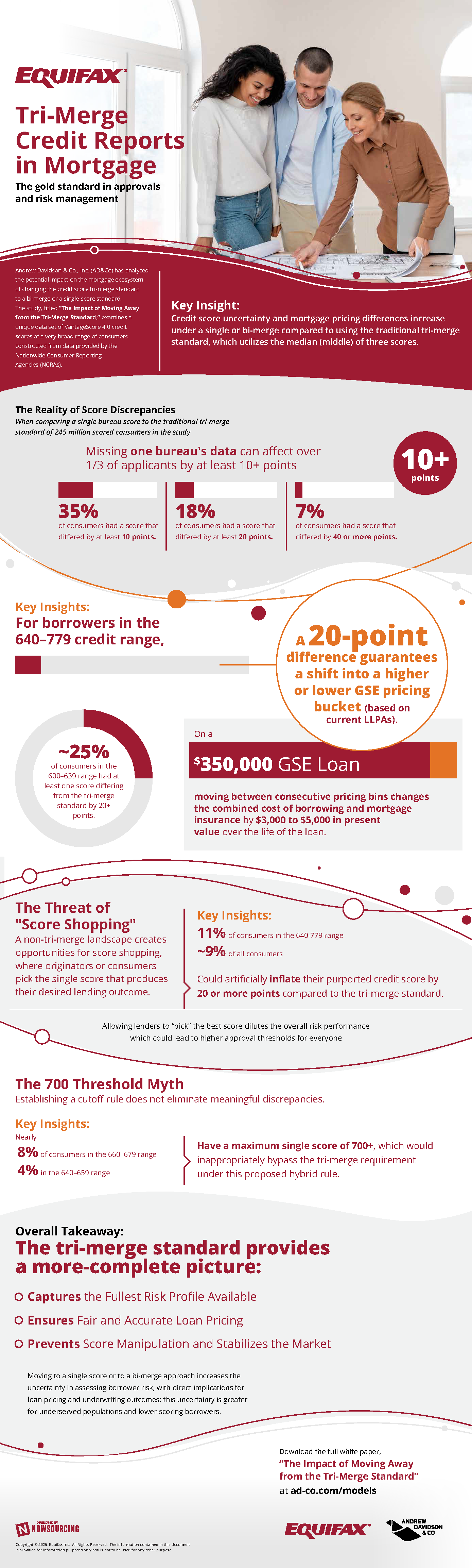
Source: Equifax
 Bill Bennett: Fixed Voice Rules Head For Deregulation
 UN Department of Global Communications: United Nations Proposes New Global Dashboard To Measure Progress Beyond GDP
 Banking Ombudsman Scheme: Fraud Check Delays Well Worth The Inconvenience, Says Banking Ombudsman
 Asia Pacific AML: NZ’s Financial Crime Gap - Beyond The 'Number 8 Wire' Mentality
 Westpac New Zealand: Kiwi Households Adapting Despite Widespread Cost Pressure Concerns, Westpac Survey Shows
 University of Auckland: Kids’ Screen Use Linked To Long-Term Deficits In Self-Control And Attention


