
 Scoop has an Ethical Paywall


New Book “The NO Test” Challenges The Core Misrepresentations Of Domestic Violence
Imagine living in a society with significantly lower — or even zero — rates of domestic violence and sexual assault. A society where women’s refuges are no longer needed, divorce rates fall, and family courts are no longer overwhelmed by cases?
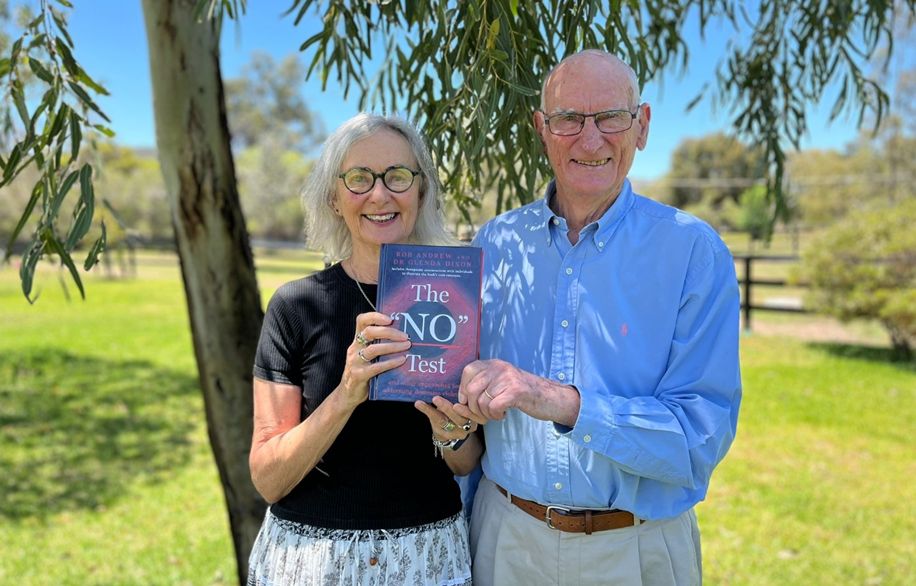
Later this month, two respected domestic violence counsellors, Perth-based Rob Andrew and Central Otago-based Dr Glenda Dixon, will launch their transformative new book, The “NO” Test — a 390-page, 16-chapter exploration of how domestic violence is represented (or more accurately, misrepresented) in society today.
The pair, who share similar counselling principles in their practices today, previously worked as colleagues in Perth’s Relationships Australia Domestic Violence service for several years until December 2013.
Now living 5,200 km apart, Andrew and Dixon have collaborated on their inaugural book, designed for both professionals and the wider community, which draws from over 30 years of combined experience and learnings within the domestic violence sector.
At its heart, The “NO” Test reframes the dialogue between men and women in relationships, and importantly, identifies the early red flags of an abusive relationship.
The concept is simple:
If a man passes, he graciously accepts “no” from a woman – even though he may be disappointed. A man fails if he adopts strategies that criticise or denigrate a woman, all in the interest of her not saying no again. Or he strategises so she will change her “no” to a “yes”.
For Andrew, much of his frustration has been influenced by misrepresentation, sometimes in the media, when men are excused for their actions in the aftermath of domestic violence.
Using terms such as, “’mentally-induced’ murder”, “’ drug-induced’ assault”, or “anger management issues” can often take the responsibility off the male, says Andrew, making the woman appear “weak” or with “poor boundaries” – when in reality, they are not the problem – Andrew believes the perpetrator always knows the harm they are doing, despite coming-up against resistance from the other party.
The true “a-ha” moment for Andrew (and the title of the book), however, came from a consultation with a female client:
“A female colleague asked me, Rob, ‘How come it takes a while for me to find out what a man is like?’ I had no answer, but enquired why she’d posed the question. Her response was along these lines: ‘I am easy-going. We had been on a few dates, and all was fine. Recently, we arranged to go to a movie. When he came to pick me up, I told him I felt tired and unwell and had decided not to go out. That is when I saw a different side of him. His response was sort of, ‘How dare you?’’ We chatted about this and concluded that this was the first time she had said no, and he did not like it. We then came up with the idea of the ‘no’ test.”
Through this framework, Andrew and Dixon seek to hold men accountable for their actions while honouring women’s ongoing resistance to oppression — often unrecognised in traditional models of understanding abuse.
Correcting Misrepresentation, Reframing Respect
“The first intention of our book is to correct what we believe to be ‘common misrepresentations’ of the problem,” the authors explain.
“Secondly, it provides professionals and individuals with the skills to address attitudes such as ‘entitlement’ and ‘ownership’ in men — which act as restraints to respect — so that men recognise that passing the ‘no’ test is in their own best interests.
“And finally, it provides professionals and individuals with tools, ethical guidance, and examples of in-practice therapeutic conversations to help women who experience ongoing violations of dignity from a partner to recognise that they have always been saying no. They are not the problem — they have been subject to the problem.”
The “NO” Test is primarily focused on the pair's long-term experience with heterosexual relationships, where men are most often the perpetrators of abuse. As the authors clarify, this focus stems from:
• The high prevalence of male-perpetrated violence against women; • The need for linguistic and conceptual clarity in the discussion; and • Their extensive professional experience with heterosexual clients.
However, they emphasise that the book’s framework can also be applied more broadly to other relationship dynamics.
A Vision for Change
Andrew and Dixon pose a powerful question:
“Let us imagine a world in which men with a heightened sense of entitlement and ownership over women have become prepared to pass the ‘no’ test. How different would society be?”
They suggest the answer could be transformative:
• Women’s refuges would be largely unnecessary;
• Departments of child protection would face fewer cases;
• Restraining orders would decline;
• Divorce rates would fall;
• Family courts would see lighter caseloads;
• Police resources could be redirected from domestic callouts; and
• Violence — including partner murder — could drastically reduce or would no longer be done.
The benefits would not only be social and economic, but deeply personal. Within homes, differences would be respected and discussed. Arguments would diminish rather than escalate. Men would feel at peace and have fewer regrets.
Women would no longer walk on eggshells and live without fear or self-blame. Children would grow up in homes free from fear, tension and violence.
The “NO” Test is both a call to action and a practical guide — offering professionals, advocates, and individuals new tools to shift the conversation around respect, resistance, and responsibility in intimate relationships.
Andrew cites women move from self-blame and self-criticism to new realisations: “I was never the problem or causing him to do what he does.”
“I’m not the hopeless piece of sh*t I thought I was”, and
“I used to be ashamed of my responses, but now I see I was resisting oppression.”
“It’s not an easy fix,” the authors add. “But that’s exactly why we have written this book.”
Exclusive Launch Event (open to public) – Limited Availability
The authors will be hosting a free book launch event at The West Coast Community Centre (Peppermint Grove Library Complex) with light refreshments and a Q&A conversation, led by ABC Radio’s Geoff Hutchison on Sunday, 30 November at 1pm.
Registration to attend is essential by emailing Rob at thenotest1@outlook.com via www.the-no-test.com.au
Limited copies of The “NO” Test will be available for purchase on the day at a special launch price.
BOOK DETAILS:
Title: The “NO” Test (Greenhill Publishing)
Website: www.the-no-test.com.au/
Authors: Rob Andrew & Dr Glenda Dixon
Available: online (amazon.com.au) from Monday, 17 November Exclusive launch event: Sunday 30 November 2025, 1pm (limited seats available, email RSVP via website link is essential). Email: thenotest1@outlook.com Location: West Coast Community Centre (Peppermint Grove Library Complex), 1 Leake Street, Peppermint Grove, Perth, Western Australia
Length: 390 pages, 16 chapters
ABOUT THE AUTHORS
Rob Andrew and Dr Glenda Dixon are respected domestic violence counsellors and educators with over 30 years of combined practice. Their work in counselling, training, and advocacy has informed a new, human-centred approach to relationship therapy — one rooted in accountability, empathy, and structural change.
Rob has worked in the domestic violence field since 1993, counselling men and women and co-facilitating men’s and women’s groups. His professional fascination lies in encouraging men to examine their attitudes to better guide them towards respect and responsibility and in empowering women to unveil their ongoing resistance to oppression, commitment to dignity, and hopes for a better life.
Glenda began working in the field of domestic violence in 1994. She has a Ph.D in counselling, specialising in domestic violence. She has worked in NGO agencies, private practice and has lectured in counsellor training programmes.
 Early Childhood New Zealand: Budget 2026 Must Protect The Future Of Quality Early Childhood Education
 Creative New Zealand: Aotearoa Manu Take World Art Stage As 61st Venice Biennale Opens
 Country Music Honours: 2026 Country Music Honours Finalists Announced
 Mana Mokopuna: Children’s Commissioner Welcomes New Youth Mental Health And Suicide Prevention Services In Te Tai Tokerau
 New Zealand Kindergartens: 100-Years On - Investing In Teacher-Led, Quality Early Childhood Education Is Investing In Aotearoa’s Future
 Dry July: Thousands Set To Go Alcohol Free This July As Cancer Diagnoses Continue To Rise Across Aotearoa