
 Scoop has an Ethical Paywall


80 Years Since Hiroshima And Nagasaki: Ōtautahi Christchurch Remembers As NZ’s Nuclear-Free Legacy Comes Under Pressure
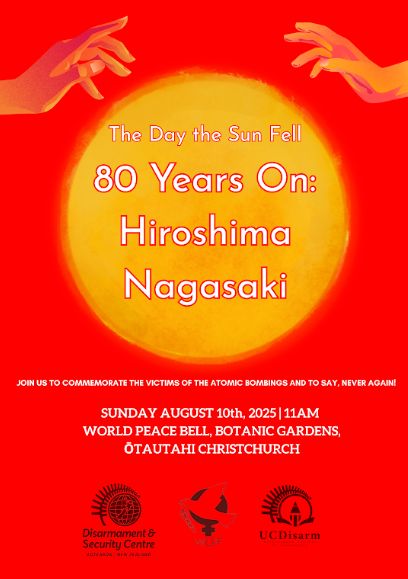
On Sunday 10 August at 11am, a public commemoration will be held at the New Zealand World Peace Bell in the Christchurch Botanic Gardens to mark 80 years since the atomic bombings of Hiroshima and Nagasaki.
On 6 August 1945, the United States (US) dropped the first nuclear weapon ever used in warfare on the Japanese city of Hiroshima. Three days later, on 9 August, a second bomb was dropped on Nagasaki. The devastation in both cities was immense. Over 200,000 people initially died from the atomic bombings, and by the end of 1945 a further 200,000 had succumbed to injury and radiation poisoning. The long-term effects on hibakusha (survivors) and their descendants remain profoundly traumatic and continue to this day. In 2024, the Nobel Peace Prize was awarded to the Japanese hibakusha group Nihon Hidankyo (Japan Confederation of Atomic and Hydrogen Bomb Sufferers Organisations), recognising their decades of advocacy for nuclear disarmament.
Their message has never been more urgent. Last year, the nine nuclear-armed states—the US, Russia, China, the United Kingdom, France, India, Pakistan, North Korea, and Israel—increased spending on their arsenals by 11%, pouring a record US$100.2 billion into nuclear weapons—fuelling global instability. In January 2025, the Bulletin of the Atomic Scientists moved the Doomsday Clock to 89 seconds to midnight—its closest point ever—citing an unrelenting nuclear risk and the erosion of global arms control agreements.
Advertisement - scroll to continue readingThere is a common perception that nuclear weapons are a thing of the past—but the numbers remain deeply alarming. Together, the nine nuclear-armed states possess over 12,200 nuclear warheads, with the US and Russia alone holding 90% of the total. A further six countries—Belarus, Belgium, Germany, Italy, the Netherlands, and Turkey—host nuclear weapons on their territories. Today, approximately 3,900 warheads are deployed, with around 2,000 on high alert, ready to launch within minutes. As Nihon Hidankyo co-chair Terumi Tanaka warned at the Nobel ceremony: “Any one of you could become either a victim or a perpetrator, at any time.”
Recent events have only underscored this warning. The June 2025 conflict between Israel and Iran exposed the failure of nuclear deterrence thinking and set a dangerous precedent. Iran, which does not possess nuclear weapons, was attacked by two nuclear-armed states—the US and Israel—seeking to prevent it from acquiring the very weapons they themselves hold. This crisis reveals a deeper truth: nuclear weapons do not guarantee security. Iran now sees that pursuing them offers no real protection, while Israel’s nuclear arsenal failed to deter retaliatory strikes from Iran. Deterrence breeds mistrust, escalation, and pre-emptive violence. The result is a cycle of fear that brings the world closer to catastrophe—not peace. Nuclear weapons don’t keep us safe—they keep us trapped.
In recent days, tensions between the US and Russia have also worsened. Following an online exchange with former Russian President Dmitry Medvedev, US President Donald Trump ordered the positioning of nuclear-armed submarines closer to Russia. This kind of brinkmanship is a stark illustration of the fallacy that some states can be “trusted” with nuclear weapons while others are deemed too “irrational” to possess them. These actions reflect the increasingly reckless nature of nuclear posturing in global politics—and the urgent need for renewed leadership on disarmament.
New Zealand has long been a global leader in nuclear disarmament. Our 1987 nuclear-free legislation was historic, and Aotearoa was among the first to ratify the 2017 Treaty on the Prohibition of Nuclear Weapons (TPNW), which now has 73 states parties. But that proud legacy is at risk of being diluted.
In Budget 2025, the New Zealand Government halved the Disarmament Education United Nations Implementation Fund with the stated intention of completely “disestablishing” it from 2026. This is a fund that has supported community groups and educators for over two decades. With a modest annual budget of just $200,000, it has helped ensure future generations understand and uphold our nuclear-free identity. At a time of rising nuclear risks, its removal sends the wrong signal: that New Zealand is stepping back from values-based leadership on nuclear disarmament just when the world needs it most.
The commemoration ceremony of Hiroshima and Nagasaki this year in Christchurch is not only a moment of reflection—it is a call to action. This event is a chance to honour the survivors of Hiroshima and Nagasaki, and to remind New Zealand’s leaders that disarmament is not just history, but a pressing national and global responsibility to ensure no one ever endures what the hibakusha did on those horrific days 80 years ago.
EVENT DETAILS:
Title: The Day the Sun Fell. 80 Years On: Hiroshima and Nagasaki
Date: Sunday, August 10th, 2025
Time: 11:00am - 11:45am
Location: New Zealand World Peace Bell, Christchurch Botanic Gardens
Invitation: The event is free and open to the public.
Speakers and attending dignitaries:
Deputy Mayor of Christchurch Pauline Cotter
Christchurch City Councillor Dr Melanie Coker (Keynote)
Japanese Consul, Mr Ken Nakamura
University of Canterbury Associate Professor of Japanese, Dr Susan Bouterey
Christchurch City Councillors and local Members of Parliament
Schedule of Events:
11:00 - 11:05 Opening Remarks
11:05 - 11:07 Keynote Address (Cr Coker)
11:07 Candlelight Vigil and Ringing of Bell by Deputy Mayor
11:08 Moment of Silence
11:09 Speech (Mr Nakamura)
11:12 - 11:40 Singers and other speeches
11:45 Public invited to ring World Peace Bell and place flowers on River Avon
About the Disarmament and Security Centre:
The Disarmament and Security Centre (DSC) is a not-for-profit charitable organisation based in Aotearoa New Zealand. The DSC was established in 1998 in Christchurch and today operates as primarily a virtual Centre connecting disarmament experts, lawyers, political scientists, academics, teachers, students and disarmament proponents. We provide a resource centre for alternative thinking on disarmament and security issues, both within Aotearoa New Zealand and internationally. Currently our work focuses on: raising public awareness on disarmament issues by implementing the recommendations from the 2002 United Nations Study on Disarmament and Non-Proliferation Education; educating about New Zealand’s nuclear free legislation; informing the public on the World Court's 1996 Advisory Opinion on nuclear weapons and its implications; raising awareness of the 2017 Treaty on the Prohibition of Nuclear Weapons, the fallacies of nuclear deterrence; and offering safer alternative security strategies.
For more information visit www.disarmsecure.org
 Gordon Campbell: On Children’s Book Classics - The Moomins
 Nelson City Council: Mayor Welcomes Auditor-General Decision Not To Prosecute Councillor
 Johnnie Freeland: Ko Tātou Tātou - Climate Action In Aotearoa Begins With Relationship
 Zero Waste Network Aotearoa: Container Return Scheme Bill Would Double Recycling Rates And Put Money Back In Households
 Wellington City Council: Statement From The Wellington Mayoral Forum On Options For Regional Governance Reform
 MUNZ: TAIC Report On Kaitaki Incident Gives Shocking Picture Of Decline Of NZ Maritime Infrastructure
 Greenpeace: New Climate Report Yet More Reason To Reduce Dairy Herd


