
 Scoop has an Ethical Paywall


'Urgency' Needed Over Climate Adaptation Funding, Insurance Council Says

Kate Newton , Climate Change Correspondent
There are no plans to speed up decisions about who will pay to protect or move communities threatened by climate change hazards, the climate change minister says.
That is despite the Insurance Council and others pleading for urgency, saying severe weather is not going to wait.
Communities on the East Coast - which was hit again by Cycle Vaianu - are among those discussing whether they need to retreat to safer locations as the risk of coastal and inland flooding grows.
Adaptation plans in some places, such as South Dunedin, are already well advanced.
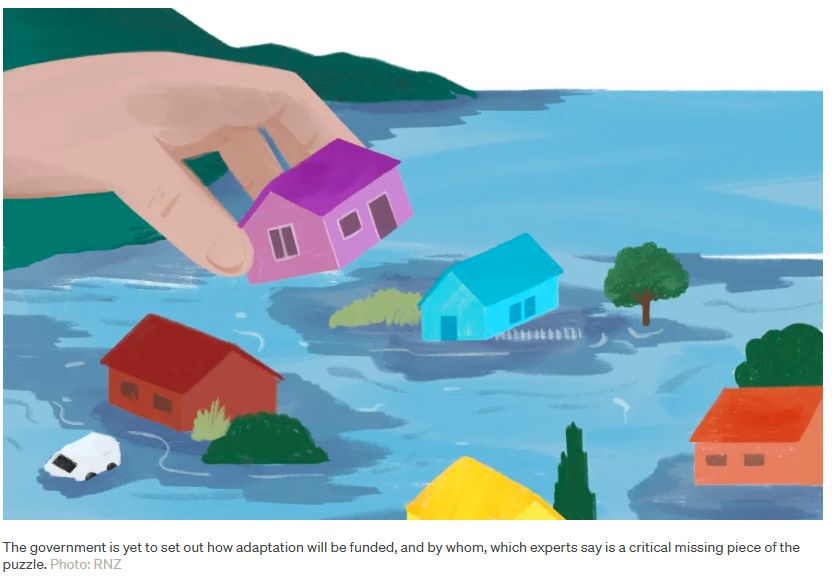
However, the government is yet to set out how adaptation will be funded, and by whom, which experts say is a critical missing piece of the puzzle.
Late last year, Climate Change Minister Simon Watts released a 16-point adaptation framework setting out the government's approach to identifying and managing the risk from climate change-related hazards.
That included a proposed amendment to climate change laws, to require councils to identify high-risk areas in their jurisdictions and develop adaptation plans to cope.
However, that amendment has not been introduced to Parliament yet.
In a Cabinet paper approving the framework, Watts proposed deferring decisions on cost-sharing to the next electoral term.
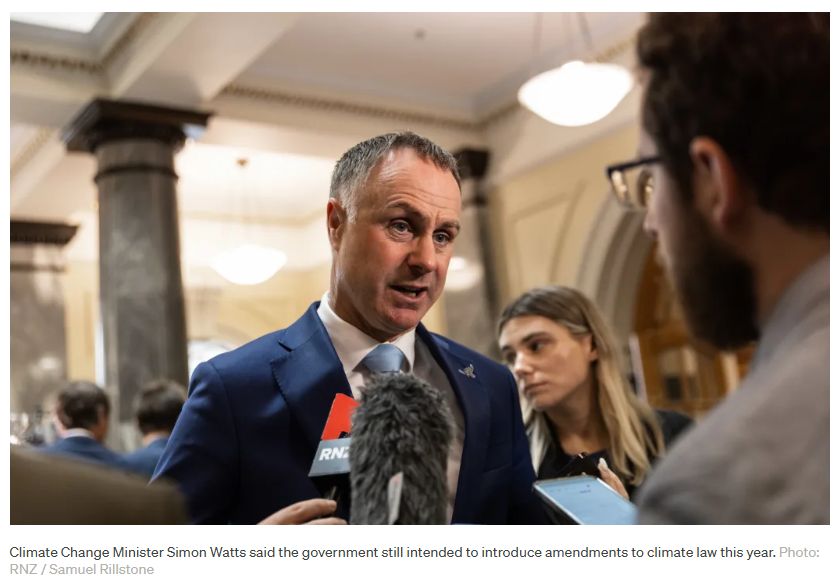
In a written response to RNZ, Watts said the government still intended to introduce amendments to climate law this year, "including ensuring councils prepare adaptation plans for priority areas, which will help build resilience".
There was no change to the time-line for work on cost-sharing, he said.
"Further decisions will be worked through in the next term of government. It is a complex area and one where it is important to take the time to get things right."
Insurance Council chief executive Kris Faafoi said each month of 2026 so far had featured "a relatively impactful event".
"The weather is not going to wait for parliamentarians."
Communities and councils were looking for leadership, Faafoi said.
"The framework is good, but now we need some urgency and certainty on some of the tools that councils can have."
RMA reforms and the proposed changes to climate law would help, but "none of this is going to happen without some funding", he said.
"Who is going to pay for that? We've had a strong indication from central government that that's going to be local council, but okay, let's get on with finding a way to make that affordable for local councils and ratepayers while also still being able to reduce the risk."
Simpson Grierson partner and environmental law specialist Mike Wakefield said there were some examples around the country already of communities and councils coming up with adaptation responses, but it was "not as common as we would maybe expect it to be".
Passing a law to require adaptation plans was therefore a step in the right direction, he said.
"They are a very public process that will allow the community at large to benefit from further information about risks."
Councils were fearful of legal challenges from communities and developers at the moment if they proactively identified areas at risk.
"But looking ahead, if a council was required to develop a plan ... [that] is a better situation for a council to be in, because it's doing what the law tells it to do."
The RMA reforms would build on that, he said.
Having a plan was only the first step, though, he said.
"Any form of managed retreat or adaptation is going to cost somebody something, and who pays for that is going to be a key challenge."
Requiring plans without resolving that question could create new risks.
"In terms of cracking on and doing adaptation plans, I don't think that there is anything, strictly speaking, stopping it. It just might mean that without the funding resolved, these plans gather dust and don't in fact take us anywhere further," Wakefield said.
Identifying risks without being able to resolve them "may well feed interest from the insurers as to whether or not they should continue to provide cover in certain parts of the country".
Successive governments had struggled to pass adaptation legislation.
"The reason why this legislation is taking so long ... is that property is the most valuable asset most people own and, more fundamentally, their home," he said.
"So while natural hazard risk might exist ... it's a really hard shift in mindset for homeowners to accept."
RNZ
New Zealand's public broadcaster, providing comprehensive NZ news and current affairs, specialist audio features and documentaries.
Radio New Zealand is a Crown entity established under the Radio New Zealand Act 1995. Radio New Zealand News are vital elements in our programming, providing impartial news and information to New Zealanders every day. Radio New Zealand (RNZ) provides listeners with exciting and independent radio programmes in accordance with the Radio New Zealand Charter.
 Gordon Campbell: On Pauline Hanson’s Rise, And The TOP Renaissance
 Hapai Te Hauora: New Online Gambling Laws Could Grow Harm While Claiming To Reduce It
 New Zealand Alliance Party: Alliance Party Firmly Opposes “Backdoor Privatisation” Of Kiwibank
 Taxpayers' Union: New Poll - Coalition Still Ahead; Luxon Regains 'Preferred Prime Minister' Top-Spot
 NZ National Party: Judith Collins’ Valedictory Speech
 Forest And Bird: Government Biodiversity Credit Scheme Welcomed As Opportunity For Restoration
 Office of the Ombudsman: Ombudsman Publishes Findings On Ministry Of Education Sensitive Claims Scheme

