
 Scoop has an Ethical Paywall


Broadcasting Standards Authority To Be Scrapped

Lillian Hanly, Political reporter
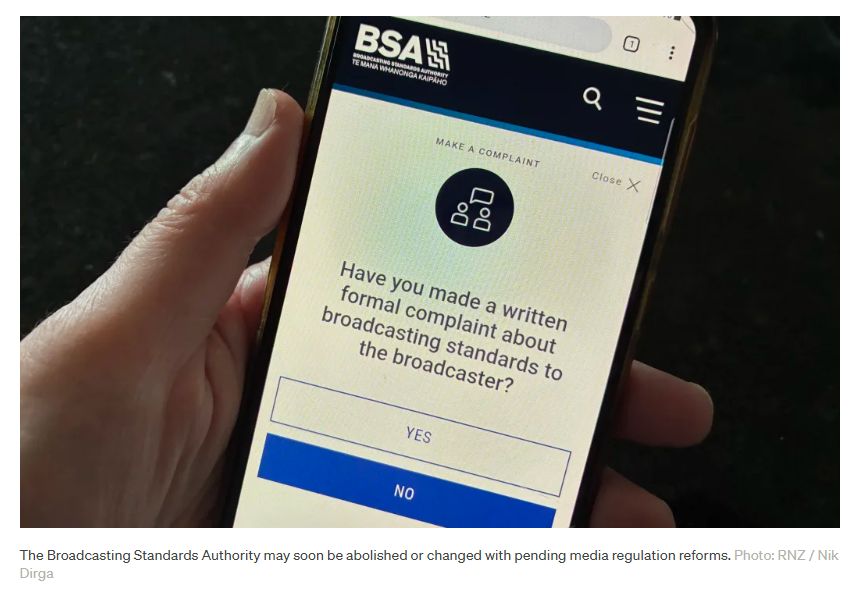
The Broadcasting Standards Authority (BSA) will be scrapped in favour of having the media self-regulate, the media and communications minister has confirmed.
Paul Goldsmith says New Zealand's media landscape has changed dramatically but "regulatory settings have not kept up" and the current framework can create inconsistencies and "unfair outcomes".
"If you've got a panel discussion on a podcast that's on demand, that's not covered, but if you've got a panel discussion on RNZ, it does, and there's no sort of logic for that," he told Midday Report.
"And so, you know, we could try and extend the brief of BSA far into sort of social media, or we could say, well, actually, why don't we just rely on the self-regulation that works fine for print journalism and set the sector free."
The BSA told RNZ in a statement it has said for more than 15 years the current Broadcasting Act "is no longer fit for purpose".
"Our primary interest has been to ensure the public continue to have access to accurate, reliable media content, and a regulator they can turn to if they think public standards are breached," its chief executive said.
Wednesday's announcement came after the BSA faced backlash from government ministers following a decision to begin regulating podcasts and online media.
A complaint sent by the BSA to The Platform was published on the online platform's website, outlining concerns raised about allegedly "unacceptable racist comments".
The letter from the BSA stated it "has found it has jurisdiction" to consider a complaint about The Platform's live talkback programme on the basis the transmission of the programme met the definition of 'broadcasting' in the act.

NZ First leader Winston Peters said at the time it was "blatant overreach" by the BSA and "highly concerning".
The BSA had since concluded it did have jurisdiction over the online media service The Platform, and published a decision saying it could consider a complaint about the show because the programme "meets the act's definition of 'broadcasting'".
Goldsmith told Midday Report the planned law change was not in direct response to that case, but it "raised the broader issue of where the boundary should lie".
ACT leader David Seymour told reporters at Parliament it was time for the BSA to go. The ACT Party had a private member's bill to abolish the BSA, which Peters hinted in April his party would support.
Goldsmith had previously said he was "leaning towards" scrapping the BSA altogether. Confirming his decisions in an announcement on Wednesday, he said the BSA was designed for a broadcasting environment that was "rapidly disappearing."
"Today, audiences move seamlessly between traditional broadcasting, on demand services, podcasts and online platforms - yet only a small portion of that content is subject to the BSA's regulatory oversight. It doesn't make sense."
He said the current framework can create inconsistencies and "unfair outcomes" for media providers, and was confident "greater industry self-regulation" was the most practical way to "level the playing field across platforms".
"The suggestion is that the Media Council would become a sort of a self-regulatory body for journalism and holding standards, and so people can go through that process," he told Midday Report.
"Alternatively, they can just turn it off and listen to somebody else. And then any entity, if they find that they're offending everybody and nobody listens to them, will soon be out of business."
Several other pieces of legislation reference the BSA. Goldsmith said legislation to repeal the provisions relating to the BSA will be drafted in coming months, and the authority would continue in its role until legislation was passed into law.
He said a bill would "probably not" be ready before this year's general election in November.
Goldsmith said if there was a shift to a self-regulation model, the government of the day should "take stock" three or four years down the line to "reassure ourselves that it's working."
"There's always the possibility to be more directive down the line, but I think it's worth having a go in this area."
BSA chief executive Stacey Wood said the authority's purpose had never been about protecting the existing operating model, and "it was clear any future regulator would need to look different to the existing BSA".
Wood said it had always been for lawmakers to decide if the authority played a role in any future regulatory setup.
"We've worked with officials and provided advice on various proposals over the years."
She said the organisation was proud of the role the BSA had played for over 37 years in maintaining standards in broadcasting. Wood said they would await further advice about the announcement and be ready to assist with the transition to new arrangements.
'Massive win' - ACT MP
ACT MP Laura McClure - whose member's bill looked to abolish the BSA - said it was a "massive win for free speech".
"Last year, radical bureaucrats at the BSA actively expanded their empire to police the internet," McClure said. "It shouldn't have taken an ACT member's bill to force action, but I am glad the minister has listened to New Zealanders' outrage."
She said ACT had called out the "blatant power grab" from the BSA, "trying to stretch a law written for rabbit-ear TVs over podcasts and livestreams".
RNZ
New Zealand's public broadcaster, providing comprehensive NZ news and current affairs, specialist audio features and documentaries.
Radio New Zealand is a Crown entity established under the Radio New Zealand Act 1995. Radio New Zealand News are vital elements in our programming, providing impartial news and information to New Zealanders every day. Radio New Zealand (RNZ) provides listeners with exciting and independent radio programmes in accordance with the Radio New Zealand Charter.
 Gordon Campbell: On The Political Panic Over Immigration
 Internal Affairs: Citizenship Test For Citizenship By Grant Applicants From Late 2027
 Dayenu: Condemning Use Of Government Funding For Extremist Report On Antisemitism
 PSA: Councils Must Work With Unions And Communities In Fast-Track Reform
 Tauranga City Council: Mauao Restoration Work Has Begun
 Horizon Research: New Poll Finds High Concern About Fuel Situation
 Tiaki Wai: Over 1,150 People Give Feedback On Tiaki Wai Water Services Strategy

