
 Scoop has an Ethical Paywall


Researchers Measure Extent Of Mouse Menace
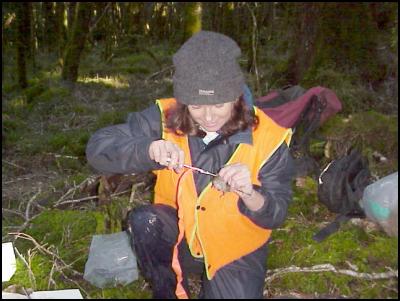
Photo: Wendy Ruscoe fitting a
singularly unimpressed rodent with an ear tag. Photo: Keven
Drew
Scientists researching the threat mice pose to beech forests have found the damage may be less to beech than to other native species.
More than 70% of New Zealand's indigenous forest is either dominated by or otherwise contains beech trees. These trees may be particularly susceptible to seed consumption by mice due to "masting", the production of large quantities of seed on an irregular 2*4 year basis. Many believe that beech trees use masting to swamp the capacity of seedeaters to eat all seeds before germination can occur. But our beech trees evolved in the absence of mice.
To determine whether mice could regularly consume all beech seed produced in a masting year, Landcare Research scientists headed to beech forests in Canterbury, and in Fiordland, where they battled dramatic extremes of weather, fleeing rising floodwaters and measuring mice in traps under a foot of snow! They monitored how many seeds mice could find and eat, and the rates of increase and decrease in mouse abundance as seed availability rose and fell.
Landcare Research scientists Dr David Choquenot and Dr Wendy Ruscoe initiated the project five years ago. Dr Ruscoe says that regardless of whether alternative food sources are available to mice, they continue to search for and consume beech seeds until (local) availability reaches zero.
"This means they are theoretically able to eliminate seed reserves in beech forests, whether or not alternative food such as native moth larvae is available.
"The rate of change in mouse abundance is closely related to seed availability, and abundance erupts in years of high seedfall. However, this rise is substantially reduced when mouse density is already high.
"The reason for this is unknown. It may be territorial behaviour, or the effects of disease."
Dr Ruscoe says that when combined and built into an especially developed mathematical model, these factors indicate that mice would rarely be able to consume all beech seed produced during moderate to heavy masting years.
"Therefore, mice are not a likely threat to the continuous presence of beech trees.
"However, seed availability appears to be important to mouse dynamics. The regular eruption of mouse abundance in high seedfall years has important flow-on effects on the numbers of mouse predators, notably stoats; and the prey they subsequently consume, notably our forest birds."
"Our research provides a more reliable basis for predicting when mouse abundance is likely to erupt, and will help refine our ideas on how to target control measures for them."
The research also highlighted a lack of understanding of the role mice play in forest ecosystems.
"The results raise critical questions about the impacts mice may have through consumption of other native plants, insects and fungi. By consuming these species as secondary food items, mice may be having a more insidious effect on forest biodiversity than their consumption of beech seeds alone may suggest.
"Given the pervasive nature of mice in beech forests, and difficulties associated with their control, there will be further research on understanding and managing their effects."
ENDS
 Google Threat Intelligence Group - GTIG: Google Threat Report Warns AI-Driven Cyber Operations Are Scaling Across Global Threat Landscape
 Commerce Commission: Baseline Research Report On The State Of Competition In New Zealand
 University of Auckland: Junk Food Designed To Make Us Eat More, Study Finds
 Spark: New Report Sets Out Outcomes-Led Approach To Lift Rural Connectivity Using The Right Mix Of Technologies
 Bill Bennett: Fixed Voice Rules Head For Deregulation
 UN Department of Global Communications: United Nations Proposes New Global Dashboard To Measure Progress Beyond GDP


