
 Scoop has an Ethical Paywall


Earth Sciences New Zealand Seasonal Climate Outlook March To May 2026
Highlights:
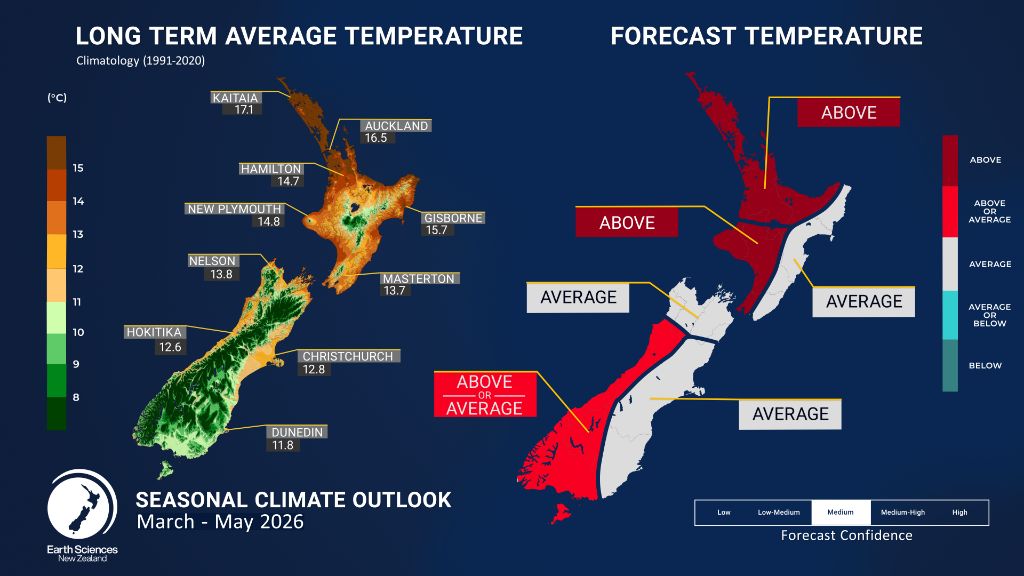
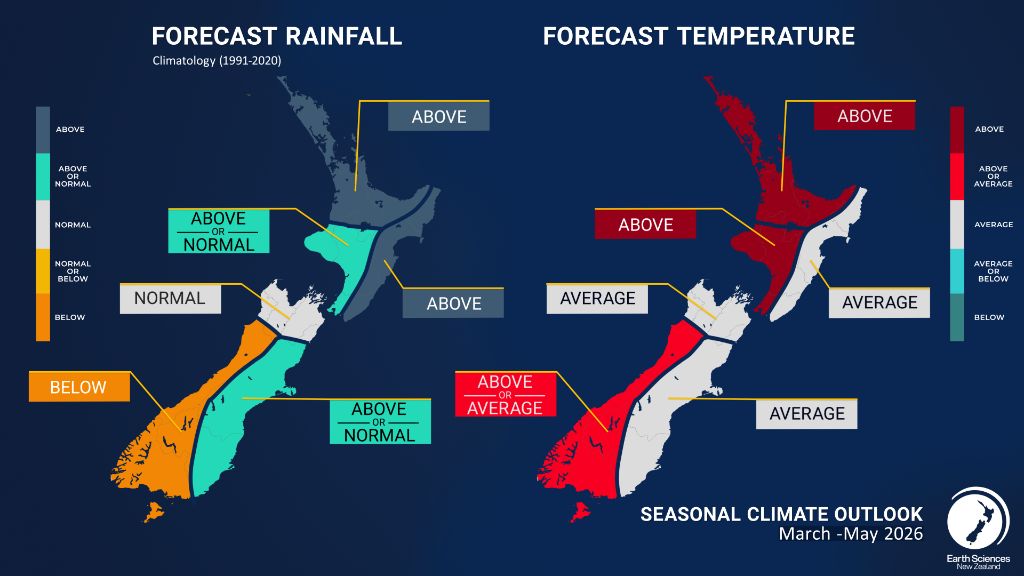
- Seasonal air temperatures for March-May 2026 are most likely to be above average for the north and west of the North Island, near average for the east of the North Island and the north and east of the South Island, and near or above average for the west of the South Island.
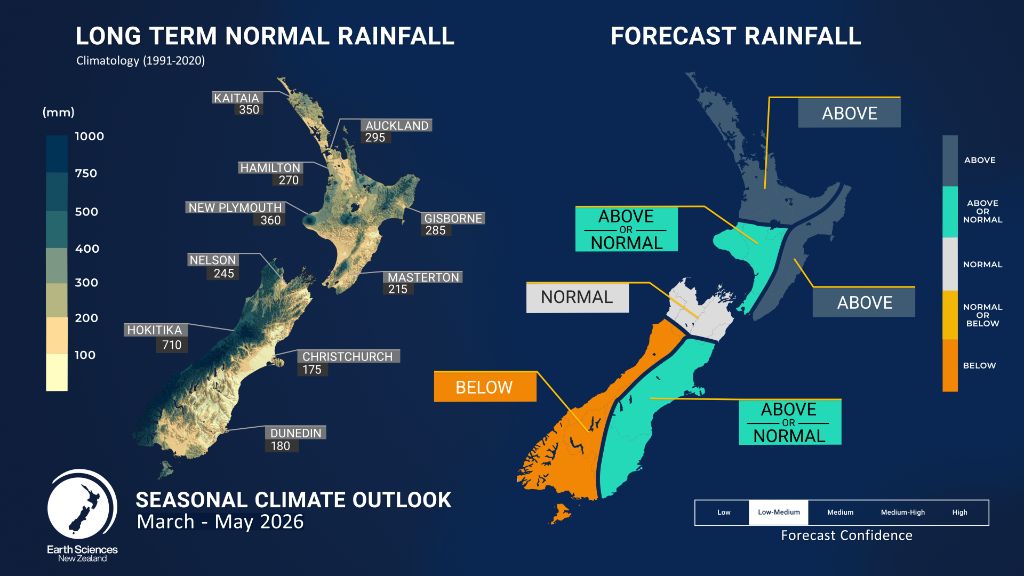
- Rainfall totals for March-May are most likely to be above normal in the north and east of the North Island. Near normal or above normal rainfall is forecast for the west of the North Island and east of the South Island, while near normal rainfall is expected in the north of the South Island. Below normal rainfall is most likely for the west of the South Island.
- There is an elevated risk of tropical-influenced weather systems bringing significant rainfall to parts of the North Island, especially at intervals in March and April.
Outlook Summary
• The coupled ocean-atmosphere system transitioned to ENSO-neutral (El Niño – Southern Oscillation) during February (i.e. neither La Niña nor El Niño). However, some remnant La Niña like circulations are expected to linger over the next few months, which may contribute to rain-bearing systems coming from the north.
• The Relative Oceanic Niño Index weakened (became less negative) in February 2026. With a value of –0.67°C, it no longer meets the LaNiña threshold of –0.7°C.
• Subsurface temperature anomalies now show a clear departure from previous LaNiñalike patterns.
• A sharp increase in Sea Surface Temperatures (SSTs) along the South American coast signalled the development of a so-called ‘coastal El Niño’, expected to be short-lived. • There is a 95% chance for ENSO-neutral conditions to remain in the Tropical Pacific over the forecast period (March – May 2026).
• Despite the seasonal predictability barrier, the development of ElNiño by winter is looking increasingly likely.
• For the next three-month period, the atmospheric circulation pattern over New Zealand is expected to see anomalous high pressure to the south of the country, and anomalous low pressure just to the north, leading to an easterly quarter flow anomaly overall.
• While autumn begins on an anticyclonic note, the risk of tropical incursions resumes from the second week of March, with unsettled conditions for the country. Although high pressure will most likely follow behind this and bring settled conditions, there is potential for another northerly sourced rainmaker near the end of the month, or in early April.
• For the remainder of April, and for May, the most likely source of significant weather is still to our north. Southern Ocean systems may be reduced in frequency, and the South Island in particular could see some prolonged settled periods.
• The Tropical Cyclone Outlook for the November 2025 – April 2026 southwest Pacific Tropical Cyclone (TC) season indicates a normal or elevated risk for ex-TC interaction for New Zealand. Although the season has been quiet so far, we remain in the peak climatological risk period for part of the outlook period, and there are indications of increased tropical activity over the next month compared with earlier in the season.
• Seasonal air temperatures for March – May 2026 are most likely to be above average for the north and west of the North Island, near average for the east of the North Island and the north and east of the South Island, and near or above average for the west of the South Island.
• Rainfall totals for March–May are most likely to be above normal in the north and east of the North Island. Near normal or above normal rainfall is forecast for the west of the North Island and east of the South Island, while near normal rainfall is expected in the north of the South Island. Below normal rainfall is most likely for the west of the South Island. There is an elevated risk of tropicalinfluenced weather systems bringing significant rainfall to parts of the North Island, especially at intervals in March and April.
• During March – May 2026, near normal soil moisture levels and river flows are expected for the west of the North Island and the east of the South Island. Near or below normal soil moisture levels and river flows are forecast for the north of the North Island and the north of the South Island, while near or above normal soil moisture levels and river flows are forecast for the east of the North Island. In the west of the South Island, near normal soil moisture levels are most likely, while near or below normal river flows are equally likely.
Regional predictions for March – May 2026
The tables below show the probabilities (or percent chances) for each of three categories: above average, near average, and below average. In the absence of any forecast guidance there would be an equal likelihood (33% chance) of the outcome for any of the three categories. Forecast information from local and global guidance models is used to indicate the deviation from equal chance that is expected for the coming three-month period. All outlooks are for the three months averaged as a whole. During these three months, there will inevitably be relatively wet and dry periods, as well as hot and cold periods. The exact range in temperature and rainfall within each of the three categories varies with location and season. However, as a guide, the “near average” or middle category for the temperature predictions includes deviations up to ±0.5°C relative to the long-term mean, whereas for rainfall the “near normal” category lies between 80 percent and 120 percent of the long-term (1991-2020) mean.
 Asia Pacific AML: NZ’s Financial Crime Gap - Beyond The 'Number 8 Wire' Mentality
 Westpac New Zealand: Kiwi Households Adapting Despite Widespread Cost Pressure Concerns, Westpac Survey Shows
 University of Auckland: Kids’ Screen Use Linked To Long-Term Deficits In Self-Control And Attention
 University of Auckland: Research To Address Equity In STEM For Māori, Pacific And Female Students
 Stats NZ: Economic Impacts On New Zealand From Conflict In The Middle East – Report
 Advertising Standards Authority: ASA Annual Report 2025 - Platform-Neutral Regulation Keeps Pace With Digital Advertising


