
 Scoop has an Ethical Paywall


Global Risks Report 2026: Geopolitical And Economic Risks Rise In New Age Of Competition
- Geoeconomic confrontation emerges as the top global risk for 2026, climbing eight positions in the two-year outlook, as economic risks rise fastest in the short term – with downturn and inflation both surging eight positions year-on-year.
- AI anxiety soars while environmental risks declined in ranking in the short term.
- Global outlook remains uncertain: half of experts expect a turbulent or stormy global outlook; only 1% anticipate calm.
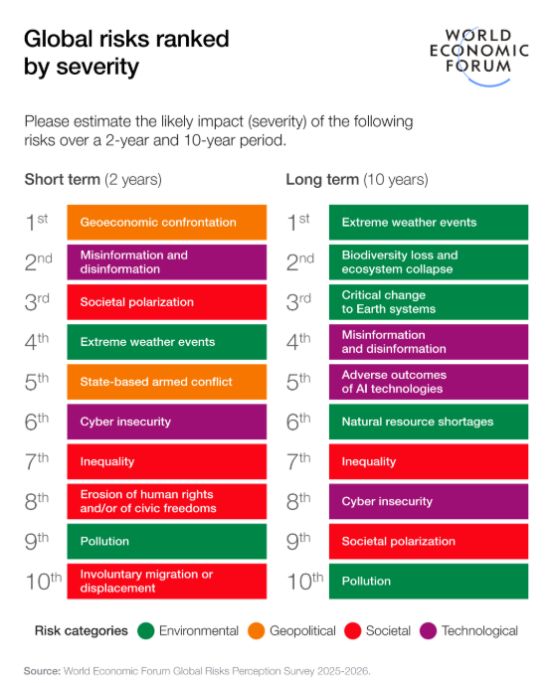
Geneva, Switzerland, 14 January 2026 – The World Economic Forum's Global Risks Report 2026, published today, finds geoeconomic confrontation emerges as the top risk for the year, followed by interstate conflict, extreme weather, societal polarization and misinformation and disinformation.
The outlook from leaders and
experts shows deep concern. Half of those surveyed
anticipate a turbulent or stormy world over the next two
years, up 14 percentage points from last year. A further 40%
expect the two-year outlook to be unsettled at the very
least, while 9% expect stability and 1% predict calm. When
it comes to the outlook for the next 10 years, 57% expect a
turbulent or stormy world, 32% expect things to be
unsettled, 10% predict stability and 1% anticipate
calm.
“A new competitive order is taking
shape as major powers seek to secure their spheres of
interest. This shifting landscape, where cooperation looks
markedly different than it did yesterday, reflects a
pragmatic reality: collaborative approaches and the spirit
of dialogue remain essential,” said Børge Brende,
President and CEO, World Economic Forum. “Our Annual
Meeting in Davos will serve as a vital platform for
understanding risks and opportunities and for building the
bridges needed to address them.”
“The
Global Risks Report offers an early warning system as the
age of competition compounds global risks – from
geoeconomic confrontation to unchecked technology to rising
debt – and changes our collective capacity to address
them. But none of these risks are a foregone conclusion,”
said Saadia Zahidi, Managing Director, World Economic Forum.
“The challenges highlighted in the report underscore both
the scale of the potential perils we face and our shared
responsibility to shape what comes next.”
The
report analyses risks across three timeframes: immediate
(2026); short-to-medium term (the next two years); and long
term (the next 10 years). In the near term, armed conflict,
the weaponization of economic tools and societal
fragmentation are colliding. As these immediate risks
intensify, longer-term challenges from technological
acceleration to environmental decline are also creating
knock-on effects.
Geopolitical,
economic and geoeconomic risks
surge
Geoeconomic
confrontation tops the near-term rankings, with 18%
of respondents viewing it as the risk most likely to trigger
a global crisis in 2026, as well as being ranked 1st for
severity over the next two years, up eight positions from
last year. State-based armed conflict
follows in 2nd position for 2026, dropping to 5th position
in the two-year timeframe.
In a world of rising
rivalries and prolonged conflicts, confrontation threatens
supply chains and broader global economic stability as well
as the cooperative capacity required to address economic
shocks. When it comes to the geopolitical outlook, 68% of
respondents expect a "multipolar or fragmented order" over
the next decade, up four points from last
year.
Economic risks show the largest
collective increase in the two-year outlook.
Economic downturn and
inflation risks both surged eight
positions, to 11th and 21st respectively, while
asset bubble burst rose seven to 18th
position. Mounting debt concerns and potential asset
bubbles, amid geoeconomic tensions, could trigger a new
phase of volatility.
Technology,
societies and the
environment
Misinformation and
disinformation ranks 2nd on the two-year outlook
while cyber insecurity ranks 6th.
Adverse outcomes of AI show the starkest
trajectory, climbing from 30th in the two-year horizon to
5th in the 10-year horizon, reflecting anxiety about
implications for labour markets, societies and
security.
Societal
polarization ranks 4th in 2026 and 3rd by 2028.
Inequality is in 7th position in the two-
and 10-year outlooks. Inequality was also selected as the
most interconnected risk for a second consecutive year,
fuelling other risks as social mobility falters.
Economic downturn is the second-most
interconnected. Underlying these interconnections are
concerns about cost-of-living pressures and K-shaped
economies becoming entrenched.
With short-term
concerns overtaking long-term objectives, environmental
risks declined in ranking in the two-year outlook.
Extreme weather dropped from 2nd to 4th,
pollution from 6th to 9th, while
critical change to Earth systems and
biodiversity loss fell seven and five
positions respectively. All environmental risks declined in
severity score, representing an absolute shift, not just a
relative one. Yet over the 10-year period, they remain the
most severe – the top three are extreme weather,
biodiversity loss, and critical change to Earth systems.
Three-quarters of respondents expect a turbulent or stormy
environmental outlook, the most negative of any
category.
About the Global Risks
Report
The Global Risks Report is the World
Economic Forum's flagship publication on global risks, now
in its 21st edition. The report leverages insights from the
Global Risks Perception Survey, which draws on the views of
over 1,300 global leaders and experts from academia,
business, government, international organizations and civil
society, as well as the Global Risks Report Advisory Board,
the Global Future Councils Network and the Forum’s C-suite
communities. The report identifies and analyses the most
pressing risks across immediate, short- and long-term
horizons, aiming to equip leaders with foresight to address
emerging challenges and foster collective action to build a
more resilient future. For more information, visit the Global
Risks Initiative and read the full report here.
The
Forum's Scenarios for the Global Economy Dialogue Series
complements this approach to building foresight. Two recent
publications explore the strategic implications for
businesses of different trajectories for the global economy
to 2030. Four
Futures for the New Economy examines the
interaction of geopolitical and technology drivers, while Four
Futures for Jobs in the New Economy focuses on
critical uncertainties on AI and talent trends. Both offer
tools to navigate uncertainty, identifying indicators to
watch, implications of each scenario and no-regret moves to
prepare for multiple futures.
About the
Annual Meeting 2026
The World Economic Forum’s
56th Annual Meeting, taking place 19-23 January 2026 in
Davos-Klosters, Switzerland, will convene leaders
from business, government, international organizations,
civil society and academia under the
theme, A Spirit of
Dialogue.
 UN Special Procedures - Human Rights: Israel Must Immediately Release Gaza-Bound Flotilla Activists, Say UN Experts
 IPMSDL: Condemn The Killing Of Children, Bombing In Manipur, And Violent Repression Of People’s Protests
 Médecins Sans Frontières: Three Years On, Outbreaks Everywhere - MSF Urges Boost To Sudan’s Vaccination Programs
 UN News: Uncertainty Continues Over Safety In The Strait Of Hormuz
 Australian Museum: Celebrate Sir David Attenborough's 100th Birthday With The Australian Museum
 Clean Shipping Coalition: Shipping - IMO’s Net Zero Framework Progresses But ENGOs Slam Unnecessary Delay