
 Scoop has an Ethical Paywall


Wild kiwifruit a serious threat to environment
MEDIA RELEASE
Wild kiwifruit a serious threat to
environment
For immediate release: Wednesday 8 June
2005
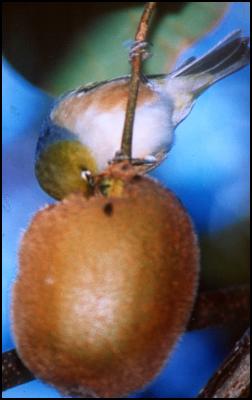
CAPTION: Bird snack on ripe kiwifruit and then spread the seeds.
Kiwifruit orchardists and farmers are being asked for their help in limiting the spread of wild kiwifruit in the Bay of Plenty.
Wild kiwifruit has been growing in the native bush gullies and small exotic forestry blocks of the Te Puke district since the 1970s. It has now established further afield, around Katikati, Opotiki and parts of the Rotorua district.
Environment Bay of Plenty pest plant coordinator John Mather says kiwifruit seeds are often spread by birds, and possibly rats and possums. “So it’s important to give them little opportunity to snack on ripening fruit,” he says.
Mr Mather asks farmers who feed reject fruit to stock to cover the piles with lengths of windbreak, a material that breathes and will not hasten fruit ripening. It’s best to feed out from the stockpile every day or two so large quantities are not left lying around, he says.
Kiwifruit orchardists can also help by removing reject fruit from vines and mulching it as soon as possible, before it ripens and birds get to it. Once fruit is dropped between rows and mulched by a mower it quickly breaks down into compost material.
Wild kiwifruit are serious environmental weeds. Vines pose a danger to native bush and exotic forest, as they are very long-lived and grow prolifically, strangling and even breaking trees. A single 30-year-old wild vine can smother 1000 square metres of scrub and young bush. Because of this, wild kiwifruit is included in Environment Bay of Plenty’s regional pest strategy as a total control plant. The regional council and the kiwifruit industry are also tackling the situation with an annual, jointly-funded control programme.
Though successful, Mr Mather says the problem may well be a long term one. “Unfortunately, the number of infestations has grown exponentially in the western Bay of Plenty. Many of the known sites are new ones, with vines less than four years old. This is probably resulting from recently distributed seeds from the thousands of tonnes of reject fruit.”
It is fortunate that most wild kiwifruit does not reproduce until it is five years old and it is thought that seeds have a relatively short life, possibly of less than five years, he adds. “These factors make it easier to control generally. However, if left to spread, this control would become increasing difficult and expensive.”
Environment Bay of Plenty has a fact sheet that describes the best ways to minimise the establishment and further spread of wild kiwifruit. Call into an Environment Bay of Plenty office for a copy, phone 0800 ENV BOP (368 267) or go to www.envbop.govt.nz. Click publications/pest plant fact sheets.
ENDS
 Gordon Campbell: On How US Courts Are Helping Donald Trump Steal The Mid-Terms
 Forest And Bird: Government Biodiversity Credit Scheme Welcomed As Opportunity For Restoration
 Office of the Ombudsman: Ombudsman Publishes Findings On Ministry Of Education Sensitive Claims Scheme
 Nelson City Council: Mayor Welcomes Auditor-General Decision Not To Prosecute Councillor
 Johnnie Freeland: Ko Tātou Tātou - Climate Action In Aotearoa Begins With Relationship
 Zero Waste Network Aotearoa: Container Return Scheme Bill Would Double Recycling Rates And Put Money Back In Households
 Wellington City Council: Statement From The Wellington Mayoral Forum On Options For Regional Governance Reform


