
 Scoop has an Ethical Paywall


Country Life: City To Farm - How Leftovers Are Giving Back To The Land

Sally Round, RNZ Journalist
It's prep time in the kitchen at Evelyn Page Retirement Village in Orewa, north of Auckland, and another load of food scraps has just gone into the bin.
Senior lead chef Dylan Hatt sprinkles some special sawdust over the top and closes the lid.
A few kilometres away in rural Wainui, a dedicated team of Year 8 students in masks and gloves, are collecting caddies from the classrooms and emptying the lunchtime food scraps into larger bins, tamping down the gloop to a gleeful chorus of "eew" and "yuck".
A few more kilometres inland, a banana farmer is at his specially built "jetty" unloading dozens of wheelie bins of food scraps into a "fast feeder" which spreads the fermented waste into ditches lined with biochar.
He then covers it all with mulch and leaves it to nourish and build the soil.
This is the chain created by City to Farm - a project run by Hibiscus Coast Zero Waste (HCZW) - to stop food waste going into landfill, to lower greenhouse gases and nourish local farmland.
"This is a way for everybody to participate in climate action with their food scraps, just sending them off to the farm," HCZW trustee Betsy Kettle told Country Life.
City to Farm collects food scraps once a week from 25 collection points in the district including kindergartens, cafes and restaurants, schools and the retirement village.
Partially grant-funded, it has diverted more than 350 tonnes of food scraps from landfill since it started in 2019.
The food scrap producers pay to have their scraps taken which also helps fund the operation, Kettle said.
"We don't call it waste. No, these are resources," she said, lifting the lids of bins in the basement of the retirement village. They have woody mulch and biochar in the base to help with the pickling process known as bokashi.
The bins are strapped down to make them airtight, ready for the weekly pick-up truck which then transports the bins to the banana farm for further composting and integrating with the soil.
One of the retirement village's residents spotted the project in the local paper and it took on a life of its own, village manager Jill Clark said.
"There's no extra work. It's just so routine. Now that's just what we do, because we've been doing it so long."
It's also become normal for the children at Wainui School.
"When we started it, we didn't really know what to think of it. We kind of just like, did it, and we were sort of like, 'eew'," Year 8 student Madison Freestone said.
"But now we do it all the time, and we do find it cool. We find it fun. We learn new things all the time."
Madison and three other Year 8s form a dedicated team of food waste busters at the rural school.
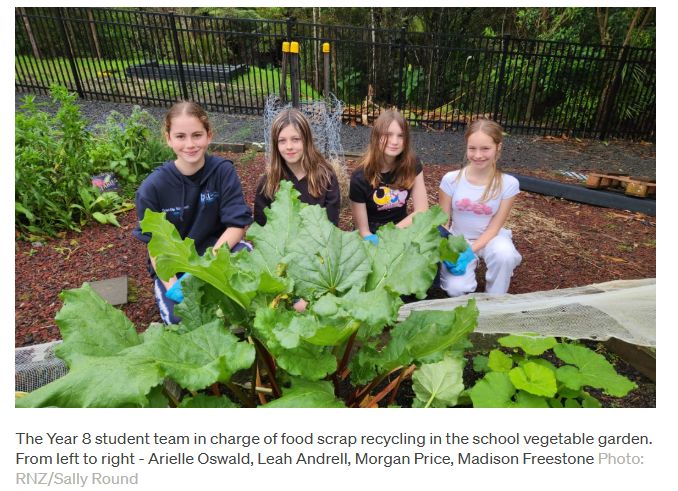
The bokashi method doesn't attract rodents, a particular problem with composting in a rural setting, principal Gillian Bray explained.
The fertiliser created from leftovers is feeding the school vegetable garden as well as City to Farm.
Kettle said City to Farm provides schools with special food scrap caddies and a little stand that also takes paper and the hard recyclables.
She said they talk to the children about the link between food scraps and greenhouse gases when placed in landfill, as well as the way food scraps, together with biochar, can build topsoil and create a carbon sink.
The Year 8 girls have taken to educating too and they're very strict about what can't go in the caddies.
"Any liquids, such as yoghurt, you know, juices, that type of stuff, no whipped cream, no meat, because the meat can make maggots grow and it's gross.
"Yeah, and obviously no rubbish. So, if someone does something wrong, we remind them that they can't put that stuff in the bin. And we tell them what they can and can't put in the bin, so that they know for next time."
Teacher Nick Wotton who leads the project at the school says the girls have taken the task on with gusto.
"Our goal is for our students to be more sustainable and environmentally responsible, and I think this, starting with the girls, is a way to sort of embed that in our students and in our culture as a whole."
Scraps to soil
Down the road from Wainui School, Phil and Jenny Grainger are hosting lunch at a large table.
Big bunches of bananas decorate their off-grid home from which wafts a delicious aroma.
Jenny has made a banana curry from bananas grown out of the once poor soil, which has been nourished by six years of food scraps.
"When we first came here, there was hardly a worm on the place," Jenny said.
The land was also dry and hydrophobic, repelling water.
The couple, former dairy and kiwifruit farmers, took on the task of taking in the food scraps to see how soil could benefit and "to sequester carbon", Phil said.
They experimented with banana swales, digging ditches and building up banks for the plants with biochar and the fermented scraps topped with mulch. Rainwater and organic matter were then able to infiltrate the clay soil.
They also developed systems to make food scrap application more efficient and not so messy, and now apply the scraps once a month using a fast feeder and orchard tractor.
"Initially, it was having a car trailer trying to unload these wheelie bins and tipping and mud and stuff and it was disgusting and terrible," Phil said.
The Graingers have planted more and more banana plants as the food scraps initiative has grown, and they've had the soil tested and learnt more about growing the fruit.
Other challenges emerged on-farm including rats and flies but surprisingly, odours were minimal, likely due to the bokashi fermentation process which prevented putrefaction, Kettle said.
"Although the work was messy, the impact was undeniable."
The Graingers are now transitioning into producing bananas commercially.
Kettle says her husband did some sums and they reckon half of Auckland's food scraps could be diverted from landfill onto 400 hectares of farmland.
They'd like more farmers and communities to be involved.
"The City to Farm system is meant to model a small-scale, decentralised, local-resources-for-local-use system that, hopefully, other community groups will trial in their areas.
"And if we could do that, then we would be… helping the whole planet, and the farmers would be heroes. They'd be climate heroes."
Learn more:
- Find out more about City to Farm here.
- Learn about different composting methods.
RNZ
New Zealand's public broadcaster, providing comprehensive NZ news and current affairs, specialist audio features and documentaries.
Radio New Zealand is a Crown entity established under the Radio New Zealand Act 1995. Radio New Zealand News are vital elements in our programming, providing impartial news and information to New Zealanders every day. Radio New Zealand (RNZ) provides listeners with exciting and independent radio programmes in accordance with the Radio New Zealand Charter.
 Gordon Campbell: On How US Courts Are Helping Donald Trump Steal The Mid-Terms
 Office of the Ombudsman: Ombudsman Publishes Findings On Ministry Of Education Sensitive Claims Scheme
 Nelson City Council: Mayor Welcomes Auditor-General Decision Not To Prosecute Councillor
 Johnnie Freeland: Ko Tātou Tātou - Climate Action In Aotearoa Begins With Relationship
 Zero Waste Network Aotearoa: Container Return Scheme Bill Would Double Recycling Rates And Put Money Back In Households
 Wellington City Council: Statement From The Wellington Mayoral Forum On Options For Regional Governance Reform
 MUNZ: TAIC Report On Kaitaki Incident Gives Shocking Picture Of Decline Of NZ Maritime Infrastructure

