
 Scoop has an Ethical Paywall


Glyphosate Residue Limits To Stay At 0.1mg/kg For Wheat, Barley And Oats, With Restrictions Introduced On Permitted Use
After carefully considering industry, stakeholder, and public feedback on a proposal to change maximum residue levels (MRLs) for glyphosate in wheat, barley and oats, New Zealand Food Safety (NZFS) has decided to set a limit of 0.1mg/kg (the same as the current default level) and to restrict the permitted use of glyphosate for these arable crops.
The decision reflects recent changes in how New Zealand growers are using glyphosate, says NZFS deputy director-general Vincent Arbuckle.
“Consequently, we’ve decided the existing glyphosate MRL of 0.1mg/kg is appropriate and can be set as the limit moving forward.
“Although we are confident the proposed limits would not have presented any health risks to consumers, after considering more than 3100 submissions and meeting with a broad range of submitters and stakeholders, we found compelling evidence that the way glyphosate is used in New Zealand has changed over the past five to six years.
“Growers and millers have increasingly entered into contractual arrangements that require no, or extremely low, glyphosate residues in grains used for food, effectively prohibiting pre-harvest use of glyphosate.
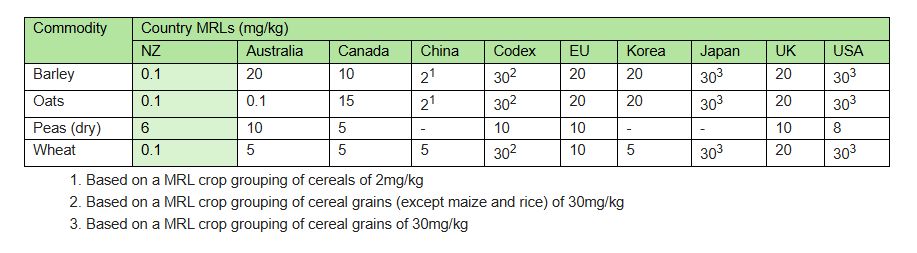
“For dry field peas, we have decided to set the MRL at 6mg/kg as proposed. This is in line with industry agricultural practice and aligns with the Australian, European Union (EU), United Kingdom (UK) and Codex MRLs of 10mg/kg for dry peas, and the United States’ 8mg/kg limit. Dry field peas are a relatively small crop in New Zealand, and the majority of product is exported to markets with similar MRLs,” Mr Arbuckle says.
To ensure that industry practice is maintained and controlled, NZFS will require (through labelling changes) that when glyphosate is used on wheat, barley, and oats grown for human consumption, it can only be applied before crops emerge. It will no longer be allowed to be applied directly onto cereal crops grown for human consumption.
Agricultural chemicals, like glyphosate, are critical for farmers and growers, Mr Arbuckle says.
“They help manage outbreaks of pests and diseases, they reduce the risks to plant and animal health, and they help keep food prices down, because crops and animals can produce more when there are fewer pests.”
NZFS regularly reviews MRLs and always consults over proposed changes. You can read the summary of submissions here: Proposed amendments to the New Zealand Food Notice: Maximum Residue Levels for Agricultural Compounds | NZ Government
Find out more about the process of setting MRLs here: How safe levels are set for chemical residues in food | NZ Government: https://www.mpi.govt.nz/food-safety-home/safe-levels-of-chemicals-in-food/how-safe-levels-are-set-for-chemical-residues-in-food
Read more about glyphosate here: Glyphosate in food | NZ Government: https://www.mpi.govt.nz/food-safety-home/safe-levels-of-chemicals-in-food/fertilisers-pesticides-hormones-and-medicines-in-food/glyphosate-in-food
Notes:
How our glyphosate MRLs compare with our trading partners
The 0.1mg/kg MRLs for barley, oats and wheat are equal to or well below MRLs set by international standard-setting body Codex and our major trading partners, including the EU, Japan, UK and US. Peas (dry) will align with our major trading partners.
 Gordon Campbell: On How US Courts Are Helping Donald Trump Steal The Mid-Terms
 Office of the Ombudsman: Ombudsman Publishes Findings On Ministry Of Education Sensitive Claims Scheme
 Nelson City Council: Mayor Welcomes Auditor-General Decision Not To Prosecute Councillor
 Johnnie Freeland: Ko Tātou Tātou - Climate Action In Aotearoa Begins With Relationship
 Zero Waste Network Aotearoa: Container Return Scheme Bill Would Double Recycling Rates And Put Money Back In Households
 Wellington City Council: Statement From The Wellington Mayoral Forum On Options For Regional Governance Reform
 MUNZ: TAIC Report On Kaitaki Incident Gives Shocking Picture Of Decline Of NZ Maritime Infrastructure


