
 Scoop has an Ethical Paywall


Ngā Kaupapa Hirahira O Te Tau: A Look Back At The Year That Was In Te Ao Māori

After the rollercoaster year that was 2024 te ao Māori may have expected that to continue into 2025 and in many ways it did with so many stories making for another unprecedented year.
The national Kapa Haka competition Te Matatini returned in February, rising to new heights of popularity with Te Tauihu group Te Kuru Marutea capturing hearts well beyond Māori circles with their powerful solos and of course there was that Waiata ā Ringa from eventual winners Te Kapa Haka o Ngāti Whakaue.
The festival has also grown to record size, this year saw 55 haka groups competing the most ever and concerns over infrastructure in smaller regions eventually led organisers to move the next festival in 2027 to Waikato, rather than to the Nelson region which had been expected to host.
2025 was also a status qou breaking year in Māori politics, which saw the deaths of influential political leaders, an unprecedented suspension from Parliament, a by-election in Tāmaki Makaurau and a bitter feud within Te Pāti Māori.
But it began with a long and drawn out Select Committee process for the Treaty Principles Bill, a record-breaking 300,000+ submissions were made on the controversial bill which was ultimately defeated near-unanimously at its second reading in April - although its architect David Seymour has promised to reignite the debate in 2026.
The first Koroneihana of Te Arikinui Kuini Nga wai hono i te po took place in September, one year on from her ascension as Māori Monarch and the death of her father Kiingi Tuheitia.
Te Ao Māori awaited eagerly to hear what Te Arikinui would say after a year of silence - and her kōrero did not disappoint. She told listeners there were many ways to manifest being Māori, "Kaua tātou e tuku mā ngā porotū kau noa e Māori ai tātou - Tino Rangatiratangatia tō reo, Mana Motuhaketia te taiao, Tino Rangatiratangatia tō hauora, Mana Motuhaketia tō pā harakeke, kei aua kaupapa rā te tino oranga mai o te Māoritanga," she said.
She also took the opportunity to launch two new economic initiatives, including a multi million dollar Kotahitanga Fund. Could that be a catalyst to take Māoridom into a post Treaty Settlement era?
Here are just a few of the stories that we had the privilege of sharing in 2025:
Dame Tariana Turia
The year had barely begun when news broke that Dame Tariana Turia, the former co-leader of Te Pāti Māori, had died at the age of 80.
At her tangihanga at Whangaehu Marae near Whanganui she was remembered as a principled politician, a fighter for her iwi, including during the 79-day occupation of Whanganui's Moutoa Gardens in 1995, but by most people simply as Nanny Tari.
She was the first of many of many Māori leaders taken in Te Kupenga o Taramainuku in 2025, less then a month later the Turia whānau were rocked again by the death of Dame Tariana's grandson Pakaitore Turia.
Rātana
The annual Rātana celebrations in January commemorate the birthday of the movements founder Tahupōtiki Wiremu Rātana and traditionally mark the beginning of the political year.
While the political talk was dominated by the Treaty Principles Bill the event also marked the first visit of the Te Arikinui Kuini Nga wai hono i te po to Rātana since the death of her father Kiingi Tuheititia.
Tainui leader Tuku Morgan described the Kiingitanga and Rātana Church as two movements inextricably bound together.
Waitangi
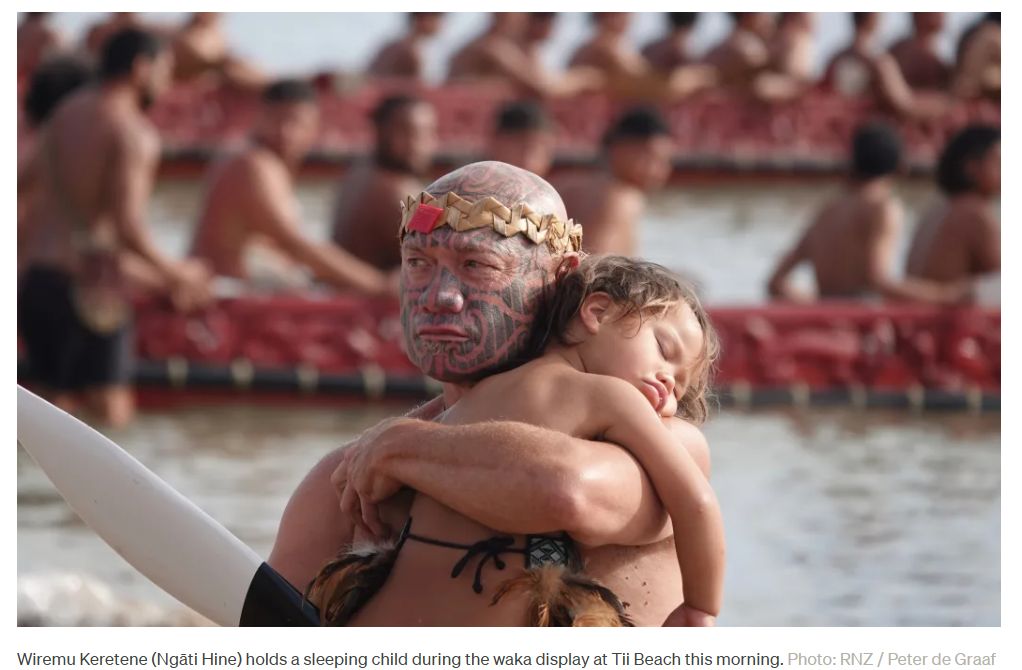
Waitangi commemorations began with the re-opening of the historic wharenui at Te Tii Marae, where at least 300 people gathered to witness the whare's new carvings, paved courtyard and earthquake strengthening.
Among the annual attractions was the annual waka parade; a staple of Waitangi commemorations and a celebration of the various vessels used by early Māori settlers.
Keen-eyed beach onlookers would also have noticed Bosco, the water surfing French bulldog, who made headlines for his aquatic antics.
Iritana Tawhiwhirangi
Māori educator Dame Iritana Te Rangi Tāwhiwhirangi, a founder of the Kōhanga Reo movement, died in early February, she was 95.
During her tangihanga at Gisborne's Te Poho o Rawiri Marae she was remembered as a stern but caring mentor, a lion, a taniwha and a keen golfer.
Many mourners made their way to Te Tairāwhiti, including Te Arikinui Kuini Nga wai hono i te po, now the patron of the Kōhanga Reo National Trust and for whom Dame Iritana was a mentor.
Te Matatini
The largest event in Māoridom, the "Olympics of Kapa Haka" Te Matatini, returned in 2025 with Taranaki and Whanganui hosting the biggest competition ever.
Te Kapa Haka o Ngāti Whakaue from the Te Arawa region emerged as Toa Whakaihuwaka, as champions on the final day at Pukekura Park in New Plymouth.
Matariki mā Puanga
For it's fourth year the Matariki Public Holiday celebrations highlighted the star Puanga (Rigel) and the communities who observe the star in their astronomical traditions.
The national hautapu ceremony was hosted this year by central North Island iwi Ngāti Rangi at Tirorangi Marae near the base of Ruapehu.
Takutai Tarsh Kemp
The MP for Tāmaki Makaurau Takutai Moana Natasha Kemp died suddenly in June at the age of 50, the Pāti Māori MP had been at Parliament working only the day before.
Before Parliament she founded the Rangatahi Mental Health Youth Hub, managed the first crew from Aotearoa to qualify for the World Hip Hop Championships in the US and lead Manurewa Marae as its chief executive through the Covid-19 pandemic.
Koroneihana
The first Koroneihana of Te Arikinui Kuini Nga wai hono i te po took place one year on from her ascension as Māori Monarch and the death of her father Kiingi Tuheitia
After a year of mourning many people were eagerly awaiting her first national address. In an emotional speech she told listeners that being Māori was not defined by having an enemy or a challenge to overcome.
Te Pāti Māori ructions
Ructions within Te Pāti Māori dominated the headlines throughout the second half of the year. It began with what should have been a moment of celebration for the party with former broadcaster Oriini Kaipara winning the Tāmaki Makaurau by-election in a landslide.
But allegations by former staffer Eru Kapa-Kingi of a "dictatorship" among the party leadership soon spiralled with Te Pāti Māori's national council voting to expel MPs Mariameno Kapa-Kingi, mother of Eru, and Tākuta Ferris.
Kapa-Kingi has since been reinstated as a member of the party, but the court decision which forced the issue will be revisited at a full hearing in early February next year. Just in time for Waitangi.
Marine and Coastal Area Act (MACA)
In October the government's changes to the Marine and Coastal Area Act (MACA) passed, making it harder for Māori groups to secure Customary Marine Title (CMT) over parts of New Zealand's coast.
The law is also retrospective meaning groups who had their title confirmed after 24 July 2024, such as the whānau of Ruapuke Island, will have to go back to court.
Veteran Māori rights activist Reuben Taipari gathered almost 20,000 signatures in only four days on a petition opposing the Bill, which he called worse than the Foreshore and Seabed Act 2004.
Ngātiwai chairman Aperahama Kerepeti-Edwards also made his feelings on the Bill clear during a debate and was ejected from Parliament's gallery for it, then a few weeks later the iwi upped the ante by landing on the Poor Knights Islands to raise a flag and erect a carved pou in protest.
Sir Tumu Te Heuheu
In September Sir Tumu Te Heuheu Tūkino VII, the Ariki or traditional leader of central North Island iwi Ngāti Tūwharetoa died, he was 84.
Succeeding his father Sir Hepi Te Heuheu as Ariki in 1997, he left behind a legacy of commitment to his iwi and to the environment. His son was named his successor, Te Rangimaheu Te Heuheu Tūkino IX.
WIPCE
After 20 years the World Indigenous Peoples' Conference on Education (WIPCE) returned to Aotearoa. Some 4000 delagates representing indigenous nations the world over descended on Tāmaki Makaurau.
The conference covered many different themes on education and many more beyond including Pacific wayfinding and indigenous food, the conference also saw the return of the Hawaiian double-hulled voyaging canoe Hōkūlea to Auckland 40 years since its voyage to Aotearoa that helped spark a revival of Pacific navigation.
RNZ
New Zealand's public broadcaster, providing comprehensive NZ news and current affairs, specialist audio features and documentaries.
Radio New Zealand is a Crown entity established under the Radio New Zealand Act 1995. Radio New Zealand News are vital elements in our programming, providing impartial news and information to New Zealanders every day. Radio New Zealand (RNZ) provides listeners with exciting and independent radio programmes in accordance with the Radio New Zealand Charter.
 Gordon Campbell: On How US Courts Are Helping Donald Trump Steal The Mid-Terms
 Office of the Ombudsman: Ombudsman Publishes Findings On Ministry Of Education Sensitive Claims Scheme
 Nelson City Council: Mayor Welcomes Auditor-General Decision Not To Prosecute Councillor
 Johnnie Freeland: Ko Tātou Tātou - Climate Action In Aotearoa Begins With Relationship
 Zero Waste Network Aotearoa: Container Return Scheme Bill Would Double Recycling Rates And Put Money Back In Households
 Wellington City Council: Statement From The Wellington Mayoral Forum On Options For Regional Governance Reform
 MUNZ: TAIC Report On Kaitaki Incident Gives Shocking Picture Of Decline Of NZ Maritime Infrastructure

