
 Scoop has an Ethical Paywall


Love For Labour Is Lacking
- Stats NZ’s suite of labour market data is out on Wednesday. The Kiwi labour market likely loosened further over the June quarter. We expect the unemployment rate to increase to 5.3% from 5.1% - the highest in over eight years.
- The moderation in wage inflation likely continued. Annual wage growth likely slowed to 2.3%, down from 2.5% - the weakest in four years. Weaker wage inflation is helping to drive further easing in domestic inflation. It’s that famous Phillips curve.
- Next week’s data should reinforce the need for further monetary policy easing. Downside risks to medium-term inflation are growing given the soft labour market and dimming global outlook. We expect the RBNZ to cut the cash rate by 25bps at the August meeting. And they’ll need to go to 2.5% eventually.
Last week’s inflation data was the first test for the RBNZ given its data-dependent approach. And we believe it opened the door to a rate cut in August. Headline rose, but thankfully, the drivers appear temporary. Domestic inflation is heading in the right direction. Next week’s labour market is the second test for an August rate cut. And should the data print the way we expect, the door to a rate cut remains firmly open.
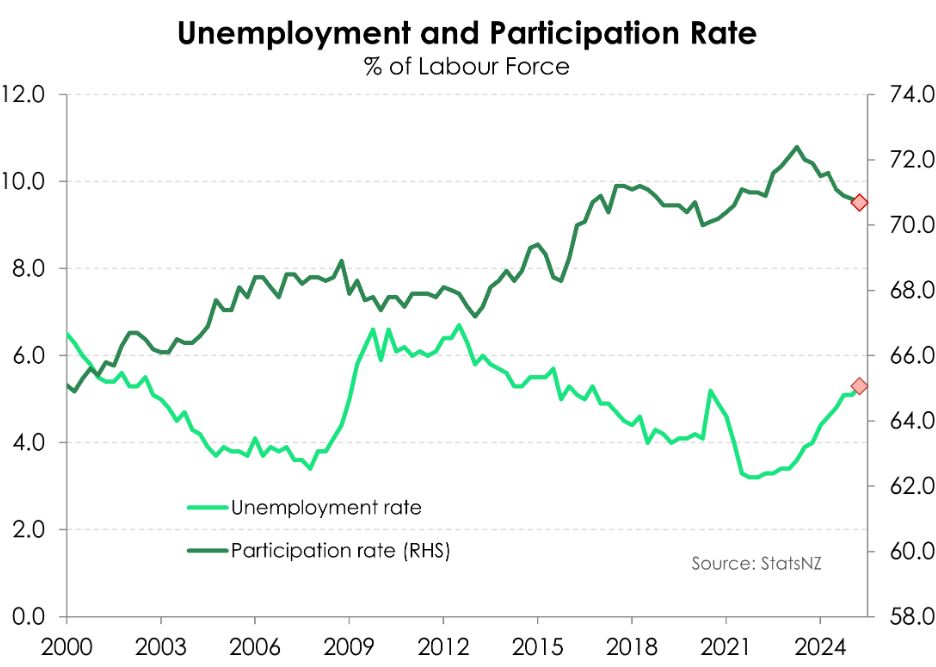
We expect the labour market to loosen further. The economy may have started to turn, with output expanding over the summer months. But the labour market lags the broader economic cycle, and the appetite for labour remains soft. Jobs growth looks to have weakened over the quarter. Stats NZ’s monthly jobs data notched a 0.3% decline over the June quarter. Filled jobs are sitting 2% below the March 2024 peak. There is a conceptual difference between Stats NZ’s filled jobs data and the Household Labour Force Survey (released on Wednesday). The former is drawn from tax data, and the latter is subject to sampling errors. Despite this, the monthly data does a good job in providing a steer on employment. Accordingly, we have pencilled in a 0.2% fall in employment over the quarter. Annually, employment growth likely weakened further to -1%. By our calculations, the unemployment rate is set to hit the highest level since December 2016, rising from 5.1% to 5.3%.
The jobs data is a key statistic before the May MPS. Our forecasts are softer than the RBNZ’s latest projections. The RBNZ sees employment growing 0.2% over the quarter, with the unemployment rate rising to 5.2% - which they forecast to be the peak in the current cycle. However, given the weakening global growth outlook, there’s risk the recovery in labour demand is delayed.
 University of Auckland: Kids’ Screen Use Linked To Long-Term Deficits In Self-Control And Attention
 University of Auckland: Research To Address Equity In STEM For Māori, Pacific And Female Students
 Stats NZ: Economic Impacts On New Zealand From Conflict In The Middle East – Report
 Advertising Standards Authority: ASA Annual Report 2025 - Platform-Neutral Regulation Keeps Pace With Digital Advertising
 Science Media Centre: Lead Pipes Banned For New Plumbing – Expert Reaction
 New Zealand Young Physicists Trust: Auckland To Host The ‘World Cup Of Physics’ In 2027; Search Begins For Student-Designed Tournament Logo


