
 Scoop has an Ethical Paywall


From Locked-Out To Let In: Tokenisation’s Promise For Everyday New Zealanders
New Zealanders have increasingly been told the same story over the past five years with escalating insistence: property is out of reach, the ladder is being pulled up and ownership is a dream slipping further away. But what if there was a mechanism that could flip that script entirely on its head?
Earlier this year in Dubai, a tokenised villa sold out in under five minutes. Not five days - five minutes. Now imagine if that was possible here in Aotearoa - owning a slice of premium commercial property without millions upfront, without waiting decades to cash out and without battling through the traditional real estate grind.
That’s what real estate tokenisation offers: fractional ownership recorded on the blockchain which enables everyday investors to buy into assets that have long been the domain of the ultra-wealthy. The technology exists now - but the question is whether our regulation will keep pace.
But this isn’t (just) about property. The same blockchain foundations that make tokenisation possible sit at the heart of a broader shift to Web3 infrastructure and decentralised finance (DeFi) globally. Around the world, crypto and Web3 regulation is moving from the margins to the mainstream with many governments racing to set the rules that will shape adoption for decades.
In this piece, we’ll look at where global regulation is heading, what’s already in play in New Zealand, and the steps we need to take now if we want to lead - rather than follow - during this next wave of financial innovation.
Global trends gathering pace
Globally, the pace of change is accelerating and in just two years, the US has pivoted from being a crypto naysayer to leading key parts of the conversation. Their landmark moves like the Genius Act, which sets a legal framework for tokenising real-world assets, and the Clarity Act, which defines how digital assets are treated under securities law, are clearing the way for tokenisation at scale.
In Europe, the Markets in Crypto-Assets (MiCA) regulation has set a single, harmonised standard for issuing, offering and providing services around crypto-assets including stablecoins, asset-referenced tokens and other digital assets across all 27 EU member states. Meanwhile the Financial Action Task Force (FAFTF) is pushing hard for alignment on anti-financial crime and consumer safety.
Institutional participation is following this clarity and hedge funds, asset managers and banks are stepping into regulated crypto markets, with 2025 already delivering notable gains.
New Zealand’s quiet advantage
But what’s happening locally? We may be small, but we’re not starting from scratch…In fact, New Zealand is unusually well-placed for real estate tokenisation. Last month, BlockchainNZ hosted Tokenised Real Estate NZ, featuring live pilots, legal infrastructure already in place and demonstrations around how our digital land title system makes us one of the most prepared markets in the world. If just 2–3% of our property market were tokenised, it could unlock over $60 billion in new transaction volume. That’s capital movement at a scale we’ve never before seen on local soil.
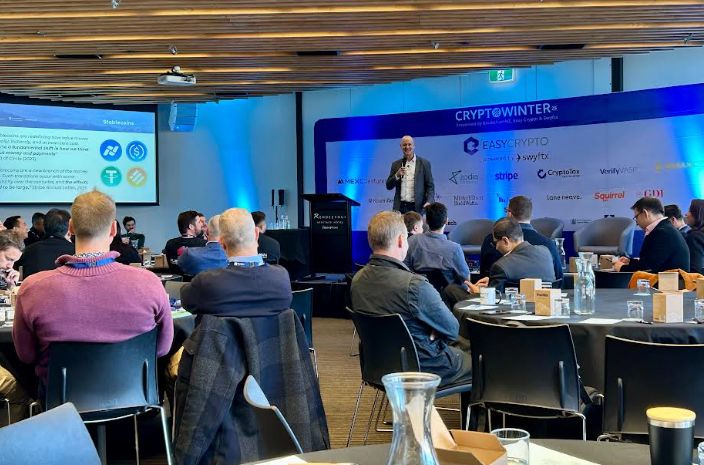
And this week, Crypto Winter 2025 will bring billion-dollar Web3 companies, local regulators including the DIA and FMA and institutional finance leaders into the same boardroom. A closed-door Policy Summit will run alongside this to help us map the last regulatory steps needed to take tokenisation from theory to mainstream reality.
We need to move faster if we want to lead
The truth, however, is that we may not be moving fast enough. While Singapore and Hong Kong are already implementing token taxonomies and building live industry-regulator pipelines, New Zealand is still leaning on blanket financial laws to cover a sector that is anything but generic.
If we want to lead, we need to sharpen our tools and this will mean defining a clear taxonomy of tokens (a formal classification system that defines the different types of tokens in the crypto/blockchain space and how they should be treated under law so everyone knows the rules they’re playing by); adopting principles-based regulation that flexes with innovation; and creating formal, ongoing channels for industry engagement.
Tax settings will be a crucial lever. Get them right, and we’ll attract global tokenisation projects; but get them wrong, and we hand opportunities to more nimble jurisdictions. A country’s tax policy can be its strongest competitive advantage or its most costly disadvantage.
Alignment, trust and the rails we need to build
This is not just about technology or finance - it’s about alignment and trust. Regulators need the confidence that industry can innovate responsibly. Industry needs confidence that regulators will move with clarity. Investors need to trust that protections match the opportunity.
We are still early, which means we have the rare chance to take a holistic approach to this that balances innovation, safety and global competitiveness. But that window is fast closing because the rails for tokenisation are being laid now and if we don’t help build them, we’ll be forced to run on tracks designed by others.
New Zealand has the legal foundation, the technical infrastructure and the capital interest to lead this market - the only question is whether we’ll take the opportunity or watch it leave the station.
-By Paul Quickenden, Chief Commercial Officer, Easy Crypto (powered by Swyftx)
 Bill Bennett: Fixed Voice Rules Head For Deregulation
 UN Department of Global Communications: United Nations Proposes New Global Dashboard To Measure Progress Beyond GDP
 Banking Ombudsman Scheme: Fraud Check Delays Well Worth The Inconvenience, Says Banking Ombudsman
 Asia Pacific AML: NZ’s Financial Crime Gap - Beyond The 'Number 8 Wire' Mentality
 Westpac New Zealand: Kiwi Households Adapting Despite Widespread Cost Pressure Concerns, Westpac Survey Shows
 University of Auckland: Kids’ Screen Use Linked To Long-Term Deficits In Self-Control And Attention


