
 Scoop has an Ethical Paywall


All Quiet On The Investment Front. Firms Wait For An Economic Clearing
- US political dramas continue to hang above financial markets. The threat of political interference in US monetary policy has steepened the yield curve. While somewhat puzzling, currency markets appear relatively unfazed.
- We recently surveyed our business bankers across the country to gauge what they were seeing around the uptake of the Government’s Investment Boost initiative. There have been some early signs of engagement. But overall, most businesses remain cautious and seem to be waiting for an improvement in economic conditions before committing to new investment
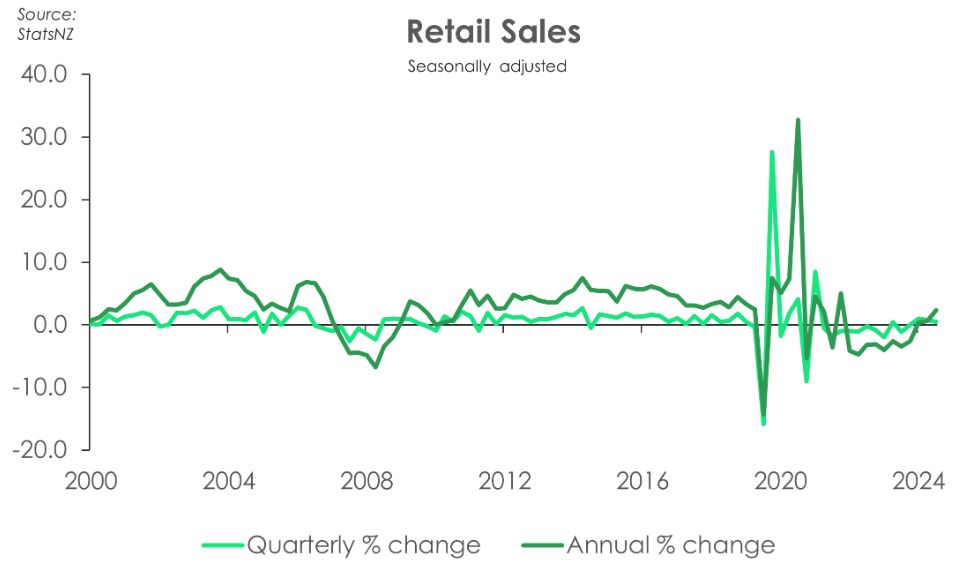
- Our COTW looks at the surprising strength in Kiwi retail sales. Volumes lifted a strong 0.5% over the June quarter, with levels now sitting 2.3% above last year. That’s great news. However, beneath the headline reveals that growth is lacking broad-based strength.
Here’s our take on current events
Political drama overshadowed economic data in financial markets last week as U.S. President Donald Trump channelled his former Apprentice persona again. This time making a dramatic move to fire Federal Reserve Governor Lisa Cook over allegations of mortgage fraud. The act quickly sparked market concerns over Trump’s ongoing challenge to the Fed’s independence. The U.S. dollar initially faced some downward pressure off the back of the news, but regained footing relatively quickly. Meanwhile, Governor Cook has responded by filing a federal lawsuit, calling the dismissal attempt unlawful and politically motivated. Ultimately, the key risk for markets from here lies in whether this rhetoric of political undermining of the Fed’s independence continues. Because such a narrative could see longer-dated U.S. rates push even higher.
Turning our focus to what we much prefer – concrete data. The Aussie monthly inflation print last week certainly caught our attention. Inflation came in well above expectations at 2.8%yoy in July – going from the bottom of the RBA’s band to close to the top. The surge was mostly off the back of a 13% increase in electricity prices due to the timing of government rebates. What was a bit of a concern was the jump in the trimmed mean measure to 2.7%. Signs that underlying inflation is pick up saw traders pare back expectations for a rate cut from the RBA this month.
Domestically, we had a relatively quiet week on the data front, so we spent some time reflecting on the Government’s ‘Investment Boost’ scheme that was announced back at the Budget in May.
As the cornerstone of the “Growth” Budget, Investment Boost serves as a tax incentive whereby businesses can deduct 20% of a new asset’s value from that’s years taxable income, on top of normal depreciation. The goal? To encourage investment in productive assets, like machines, tools, and equipment… and accelerate growth. The incentive helps Kiwi businesses to lead the growth in the economy. They know, better than most, where to invest.
Boosting investment in productive assets is something we certainly support, but it will take time to work. The timing of the initiative landed when businesses were, and still are, grappling with uncertainty, a lack of confidence, and weak demand. Businesses have been more concerned with simply surviving rather than looking to expand and invest. Businesses ‘surviving’ rather than ‘thriving’ has muted the uptake of the scheme, at least in the near term. We need a more convincing period of sustained demand in the economy. We’re closer to that now than we were in May, especially with the RBNZ signalling a shift toward stimulatory settings. Conditions are set to improve. But the here and now still poses many challenges for Kiwi businesses, with many unable or unwilling to invest.
Quantitative data on both the uptake and impact of the scheme remains limited. But we know that some of the anecdotal insights we get from Kiwi businesses paint a telling picture, well ahead of any official data.
So, we asked our business bankers across the country what they were seeing on the ground.
In response to whether clients were considering taking up the Governments “Investment Boost”, two thirds of the survey responses were no.
It’s what we expected might be the case. Businesses are still holding out for calmer waters, and a brighter outlook. And for those who did report clients taking up the scheme, it seems that most businesses using the incentive were either already planning to invest in capex or were catching up on deferred investment from the past couple of years.
Charts of the Week: Strong on the surface
Retail sales figures for the June quarter well outperfomed expectations. Most forecasters had pencilled in a contraction in retail sales volumes given the various headwinds that are still being faced by households. However, sales volumes actually lifted a solid 0.5% over the June quarter. It’s the third quarter in which retail sales have increased, following the 1% lift over the December quarter and 0.8% increase over the March quarter. The recovery is in train, with volumes up 2.3% on last year’s levels.
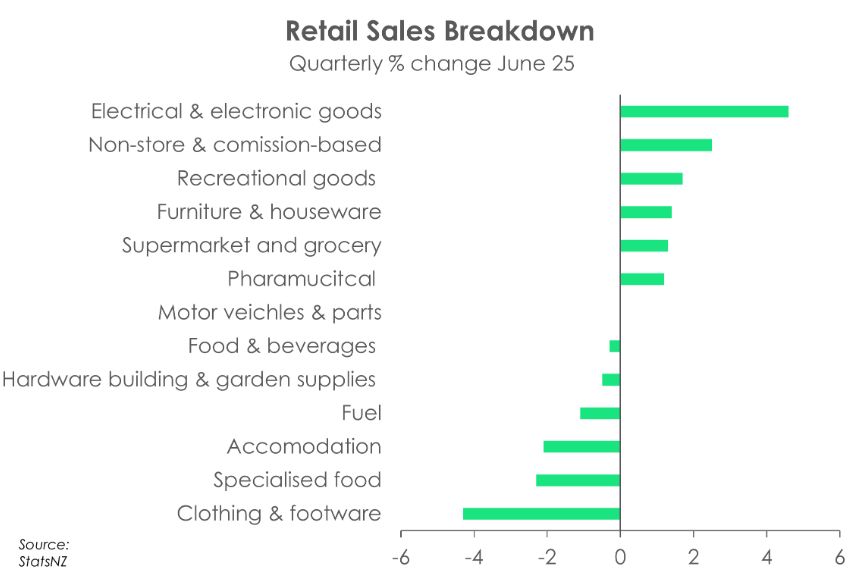
It’s an encouraging improvement and suggests the worst is behind the retail sector. But there’s still a long way to go. Stength is still lacking in some spaces, particularly across durable items. Indeed the lift in sales volume over the June quarter lacked broad based strength. About half of the measured industries still recorded a decline in sales volumes. Spend on electronic goods, up 4.6%, was the stellar perfomer over the quarter. Though we wonder whether some front loading of (discounted) imports ahead of tariffs may have spurred some spend over the quarter. Still, key areas of discretionary spending continue to lack momentum. Sales volumes on clothing & footware, accomodation, and around the home DIY all recorded sizeable declines. Sales activity was also uneven by region. Sales volumes grew 0.2% in the South Island, helped by a 2.6% increase in Otago. Meanwhile spend in the North Island fell 0.3% over the quarter, with a chunky dip in Gisborne (-3.5%) and Wellington (-1.1%).
 Bill Bennett: Fixed Voice Rules Head For Deregulation
 UN Department of Global Communications: United Nations Proposes New Global Dashboard To Measure Progress Beyond GDP
 Banking Ombudsman Scheme: Fraud Check Delays Well Worth The Inconvenience, Says Banking Ombudsman
 Asia Pacific AML: NZ’s Financial Crime Gap - Beyond The 'Number 8 Wire' Mentality
 Westpac New Zealand: Kiwi Households Adapting Despite Widespread Cost Pressure Concerns, Westpac Survey Shows
 University of Auckland: Kids’ Screen Use Linked To Long-Term Deficits In Self-Control And Attention


