
 Scoop has an Ethical Paywall


New Zealand’s Average Weekly Rent Drops Year-On-Year For The First Time In A Decade
- National average weekly rent down 1.8% in 2025 when compared to 2024
- Wellington recorded the largest drop among the major centres of 9.7% year-on-year
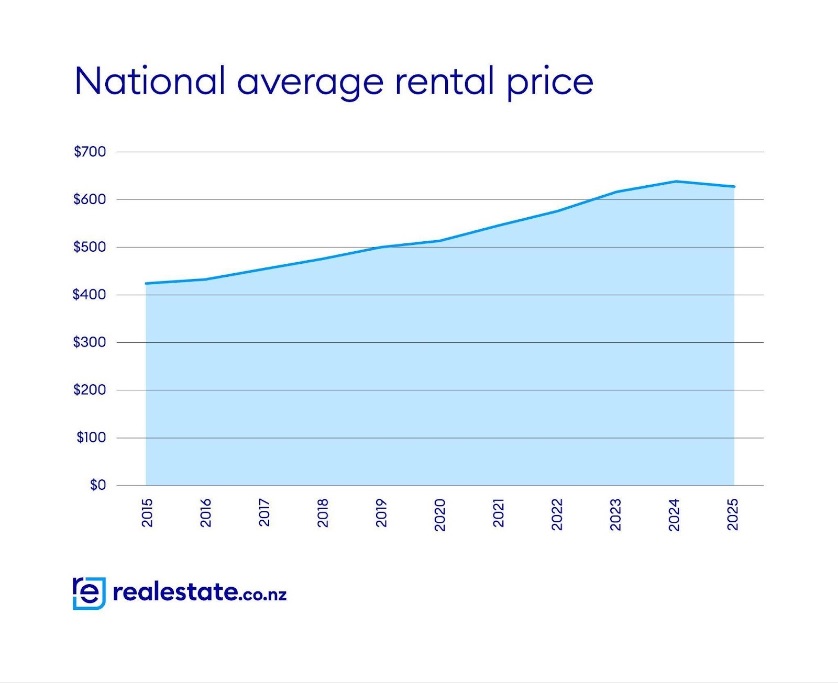
- Between 2015 and 2025, the national average weekly rent increased by almost 50%
New Zealand’s rental market has reached a new milestone, with the national average weekly rent recording its first year-on-year drop in a decade.
The latest data from realestate.co.nz reveals the average weekly rent dropped from $638/week to $627/week, demonstrating a 1.8% softening between 2024 and 2025, and marking the first annual decline since 2015.
Vanessa Williams, spokesperson for realestate.co.nz, says the fall reflects a more balanced rental market with increased listings providing renters with greater choice when searching for a new home.
“Over the past 10 years, the national average weekly rental price has shown consistent growth, from an average of $424 in 2015 to $638 in 2024. To see weekly rents fall 1.8% between 2024 and 2025 is a clear signal the market has shifted,” says Williams. “We’re seeing the effects of sustained rental supply meeting softer demand. Rental prices will need to remain realistic to be competitive.”
Where have rent prices softened the most across New Zealand?
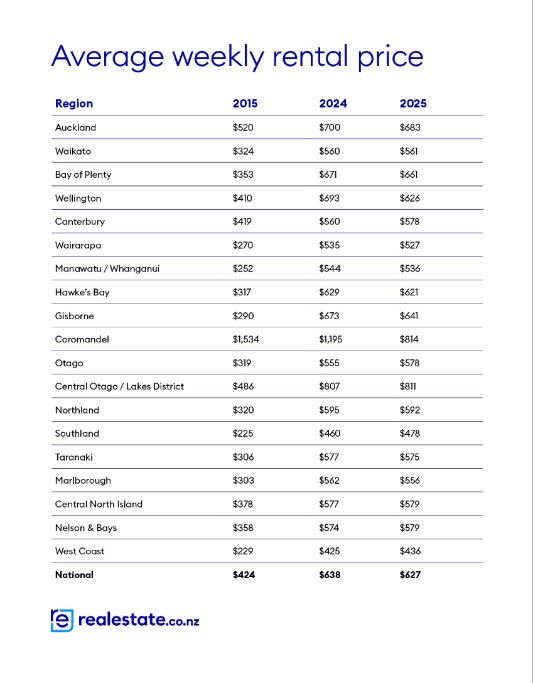
Between 2024 and 2025, the average weekly rental price fell in eight of the 19 regions.
Wellington experienced the largest drop among the major centres, with average weekly rent declining 9.7% from $693 in 2024 to $626 in 2025. Auckland also fell 2.5% from $700 in 2024 to $684 in 2025. Canterbury bucked the trend with a 3.1% increase from $560 in 2024 to $578 in 2025.
Otago (4.0%), Southland (4.0%), and the West Coast (2.6%) were the only three regions to record an increase of over 1%.
Williams says falling prices do not guarantee relief for all renters, but could present better deals for those entering the market.
“Those renewing leases or moving into new properties may benefit from these lower rates. But for tenants locked into existing contracts, the relief may come more slowly.”
How much have rental prices increased in the past decade?
Since 2015, the national average weekly rental price has increased by 47.8%, outpacing general inflation at 35.3% over the same period.*
Gisborne dominated rental price growth with the average weekly rental more than doubling in the last decade, from $290/week in 2015 to $641/week in 2025, a 121.2% increase.
Southland and Manawatu/Whanganui were the only other two regions to double their average weekly rental prices.
- Southland’s average weekly rental price increased 112.6% from $225/week in 2015 to $478/week in 2025
- Manawatu/Whanganui’s average weekly rental price increased 112.2% from $252/week in 2015 to $536/week in 2025.
Williams says for investors this highlights the long-term strength of the rental market, even amid changing conditions.
“While rents may soften in the short term, the past 10 years demonstrate that residential property has delivered consistent income growth over time.”
*Calculated using the Reserve Bank of New Zealand Te Pūtea Matua Inflation calculator
Note:
About realestate.co.nz | New Zealand’s Best Small Workplace (2025)
We’ve been helping people buy, sell, or rent property since 1996. Established before Google, realestate.co.nz is New Zealand’s longest-standing property website and the official website of the real estate industry. We are certified carbon neutral (2024 & 2025) and in 2025, realestate.co.nz was crowned Best Small/Micro Workplace in New Zealand by Great Place to Work.
Dedicated only to property, our mission is to empower people with a property search tool they can use to find the life they want to live. With residential, lifestyle, rural and commercial property listings, realestate.co.nz is the place to start for those looking to buy or sell property.
Whatever life you’re searching for, it all starts here.
Want more property insights?
- Market insights: Search by suburb to see median sale prices, popular property types and trends over time.
Glossary of terms:
Average asking price (AAP) is neither a valuation nor the sale price. It is an indication of current market sentiment. Statistically, asking prices tend to correlate closely with the sales prices recorded in future months when those properties are sold. As it looks at different data, average asking prices may differ from recorded sales data released simultaneously.
Price drop reflects the difference between a property's original asking price when listed on realestate.co.nz and its price at the point of sale or withdrawal. While it doesn’t show the final sale price, it provides a strong signal of how much sellers are adjusting to meet buyer demand.
 Bill Bennett: Fixed Voice Rules Head For Deregulation
 UN Department of Global Communications: United Nations Proposes New Global Dashboard To Measure Progress Beyond GDP
 Banking Ombudsman Scheme: Fraud Check Delays Well Worth The Inconvenience, Says Banking Ombudsman
 Asia Pacific AML: NZ’s Financial Crime Gap - Beyond The 'Number 8 Wire' Mentality
 Westpac New Zealand: Kiwi Households Adapting Despite Widespread Cost Pressure Concerns, Westpac Survey Shows
 University of Auckland: Kids’ Screen Use Linked To Long-Term Deficits In Self-Control And Attention


