
 Scoop has an Ethical Paywall


Dusting Off CVs
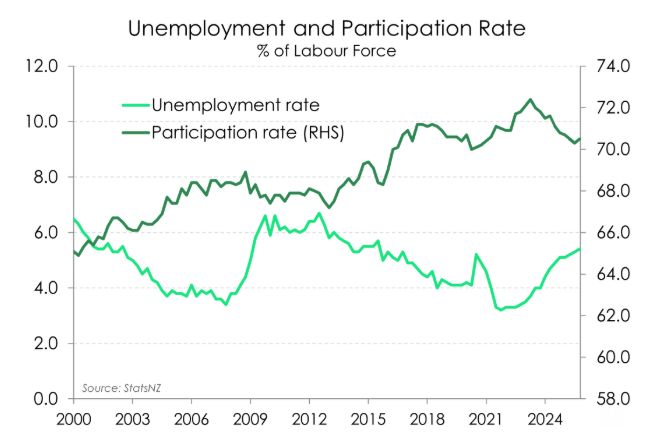
- The unemployment rate lifted from 5.3% to 5.4% in the December quarter. It’s a higher than we expected as more people dusted off their CV’s and returned to the labour force.
- Though not enough to absorb the growth in labour supply, the 0.5% lift in employment over the quarter shows that the appetite for labour is gradually improving. And overall paired with the lift in total hours worked, today’s jobs report reflected a labour market that is broadly stabilising.
- A high degree of spare capacity remains in the Kiwi economy. And it’s that slack in the market that is seeing further moderations in wage growth. Annual wage growth slowed to 2.0%. That’s the lowest in almost 5 years. That should give the RBNZ some comfort that inflation will return to the 2% target this year with wage growth far from a source of inflationary pressure.
Markets, the RBNZ, and ourselves were expecting the Kiwi unemployment rate to hold steady at 5.3% in the December quarter. Instead, the headline rate rose to 5.4%. At first glance, the move doesn’t look good. But beneath the bonnet, there’s encouraging signs of greater engagement in the labour market.
Employment growth, up 0.5% over the quarter came in stronger than we expected. And over the year, employment was up 0.2%, marking the first annual increase since June 2024. The appetite for labour is slowly improving as the economic recovery gathers pace. And it appears that signs of such a recovery have more people dusting off their CVs to test the market. As labour demand begins to recover, labour supply is responding. The labour force grew 0.6% over the quarter while the participation rate lifted to 70.5% from 70.3%.
The past two years of recession had seen the participation rate in a gradual decline as workers left the labour force discouraged by the lack of prospects in the jobs market. But now, people are putting their names back into the hat. It’s just that labour demand just isnt quite there yet. And as such we’ve seen a lift in the number of people unemployed.
The lift in employment today show that the appetite for labour is gradually improving. And 2026 should show further improvements. But it’s a slow burn with the labour demand typically lagging the broader economy. After economic downturns, employers generally want to see a steady stream of demand before expanding headcount. And we’re only at the start of our economic recovery. So it’ll take some time before the labour market can absorb new talent entering the market. But we’re at the starting line now.
There is still a significant degree of spare capacity in the economy. An unchanged underutilisation rate of 13% confirms as much. And such slack continues to weigh on wage growth. The private sector Labour Cost Index (LCI) has dropped to 2% (1.98% if we round to two decimal places) - the lowest rate since March 2021. And the distribution of annual wage growth underscored cooling wage pressures. Of those receiving pay increases, just 9% are pocketing chunky rates of more than 5%. Back in 2023, that proportion was more like 40%. Instead, more are receiving increases of 2-3% today.
 Bill Bennett: Fixed Voice Rules Head For Deregulation
 UN Department of Global Communications: United Nations Proposes New Global Dashboard To Measure Progress Beyond GDP
 Banking Ombudsman Scheme: Fraud Check Delays Well Worth The Inconvenience, Says Banking Ombudsman
 Asia Pacific AML: NZ’s Financial Crime Gap - Beyond The 'Number 8 Wire' Mentality
 Westpac New Zealand: Kiwi Households Adapting Despite Widespread Cost Pressure Concerns, Westpac Survey Shows
 University of Auckland: Kids’ Screen Use Linked To Long-Term Deficits In Self-Control And Attention


