
 Scoop has an Ethical Paywall


The RBA Hikes But The RBNZ Should Sit Tight
- The RBA hiked interest rates for the first time in over two years as inflation continues to climb. The RBA joins the Bank of Japan as the only developed central banks currently tightening policy. Kiwi inflation has climbed, but we don’t think the RBNZ should be in a rush to follow.
- Locally, our focus last week was on the Kiwi jobs market. There are encouraging signs that the appetite for labour is improving. But with an influx of people dusting off their CVs, we saw the unemployment rate rise to a decade high of 5.4%.
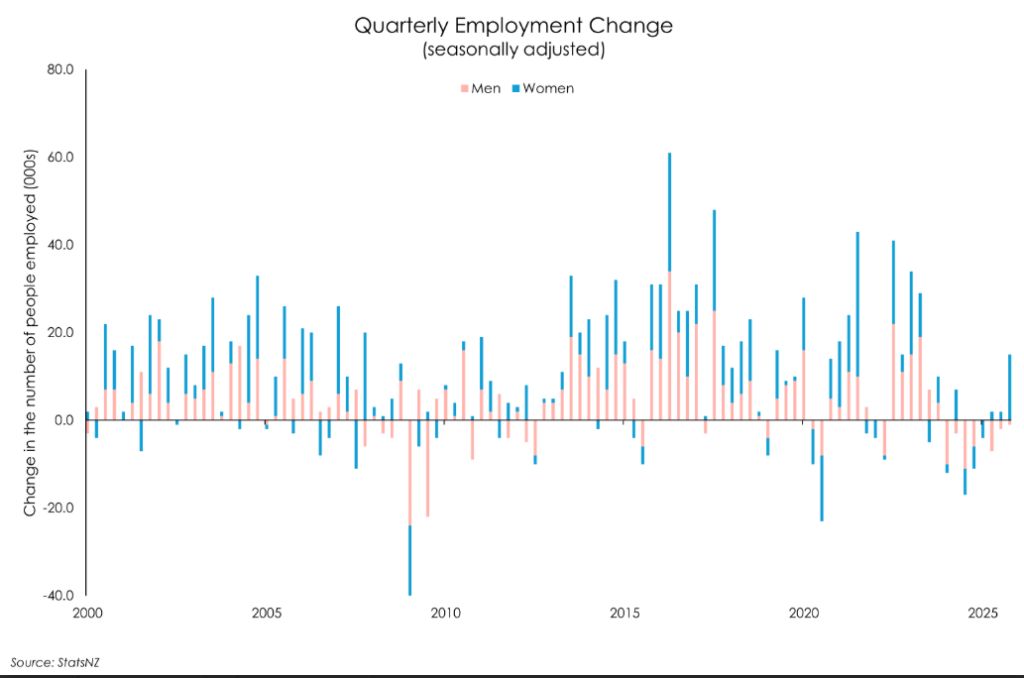
- Our COTW takes a deeper look at the greater levels of engagement in the labour market. Women appeared to be more active with an uptick in participation. And the 15k lift in people employed seen over the quarter was entirely driven by growth in female employment.
Here’s our take on current events
The RBA delivered its first rate hike in more than two years, taking the policy rate to 3.85%. Just six months ago, the RBA cut interest rates. But with this latest move, they now join the Bank of Japan as the only developed central banks currently tightening policy. The policy pivot was unanimously decided by the Board on count of the continued climb in inflation. At 3.8%, inflation has well exceeded the RBA’s 2-3% target band, and evidence points to a strengthening in private demand as the driving force. The RBA upgraded its inflation forecasts accordingly. Given a supply-constrained economy, the February statement left the door open to further hikes. Although, Governor Michelle Bullock somewhat tempered expectations of back-to-back moves.
While the RBA may be hiking, the RBNZ should be in no rush to do so here. We simply do not have the same demand pulse that is driving inflation concerns over in Aussie. The Kiwi economy instead continues to operate with a significant degree of spare capacity. And last week’s labour market report reflected just that.
The unemployment rate lifted from 5.3% to 5.4% at the end of last year – the highest in over a decade. Meanwhile the underutilisation rate, a broader measure of slack in the market, remained unchanged at 13%. And with such slack evident in the market, wages continued to cool too. The private sector Labour Cost Index (LCI) dropped to 2% (1.98% if we round to two decimal places) - the lowest rate since March 2021. The RBNZ should take some comfort in that with wage growth far from a source of inflationary pressure.
There are signs that the appetite for labour is improving with employment growing 0.5% over the quarter (see our COTW for more). It’s stronger than we expected, but not strong enough to absorb the new talent entering the market. And we saw quite the influx of fresh talent rejoin the labour force. The labour force grew 0.6% over the quarter, with the participation rate rising to 70.5% from 70.3%.
2026 should show further improvements for employment growth. But it’s a slow burn with labour demand typically lagging the broader economy. After economic downturns, employers generally want to see a steady stream of demand before expanding headcount. And we’re only at the start of our economic recovery. But at least we’re at the starting line now.
Chart of the Week: Women grow the labour force
Employment growth, up 0.5% over the quarter, came in stronger than expected. And over the year, employment was up 0.2%, marking the first annual increase since June 2024. The appetite for labour is slowly improving as the economic recovery gathers pace. And it appears that signs of such a recovery have more people dusting off their CVs to test the market.
As labour demand begins to recover, labour supply is responding. The Kiwi labour force expanded a strong 0.6% in the December quarter. It’s the strongest increase in two and a half years. Annually, the labour force has grown for the first time in a year, being 0.5% bigger than the December 2024 labour force. Interestingly, all this growth was led by women. The 14k lift in the number of people employed over the quarter was entirely driven by growth in female employment. And Stats NZ shows more women moving into managerial and professional roles. It’s a trend long in the making, and one we like to see.
The 4k increase in the number of people of unemployed was also driven by women. With more women active in the labour market, the female participation rate rose to 66.9%, the highest since September 2024.
 Westpac New Zealand: Kiwi Households Adapting Despite Widespread Cost Pressure Concerns, Westpac Survey Shows
 University of Auckland: Kids’ Screen Use Linked To Long-Term Deficits In Self-Control And Attention
 University of Auckland: Research To Address Equity In STEM For Māori, Pacific And Female Students
 Stats NZ: Economic Impacts On New Zealand From Conflict In The Middle East – Report
 Advertising Standards Authority: ASA Annual Report 2025 - Platform-Neutral Regulation Keeps Pace With Digital Advertising
 Science Media Centre: Lead Pipes Banned For New Plumbing – Expert Reaction


