
 Scoop has an Ethical Paywall


(Epic) Fury Road, A Mad Max Story
- We’ve been obsessed (and rightly so) with the conflict in the Middle East. Last week Trump gave Iran a 48-hour ultimatum to open the Strait of Hormuz, which turned into a 5-day negotiation window. The deadline then got extended, again. Now we are waiting for 6 April. We hear of de-escalation, then re-escalation, followed by de-escalation. But the war continues.
- Threats to the supply of diesel brings images of a Mad Max movie. And leaders are concerned. We will adapt and find solutions and reengineer supply chains. But there’s not a lot we can do in the near term, if South Korea decides to limit exports (for example).
- Last week RBNZ Governor, Anna Breman, delivered her speech. We like her messaging – she’s sending strong signals that the RBNZ will not be rushed into reacting to fuel costs and the (temporary?) spike in inflation.
- Beyond our COTW which covers the move (or lack thereof) in exchange rates, we are anxiously watching the diesel stores and hoping that we have enough to keep essential services going.
Here’s our take on current events
Last week, news agencies were reporting that peace negotiations were flowing both ways, and markets started reacting positively. But then there’s news that US troops have arrived in the Middle East. Iran is still acting, with attacks raining down on the region. Jordan, Oman, Kwait and Saudi Arabia are all fending off drone and missile attacks. Both sides are saying they won’t back down. The war is continuously winding down and gearing up. The risks to global supply chains are front of mind. Controlling the strait of Hormuz is the focus. It’s a revenue generator for Iran.
On Tuesday last week RBNZ Governor, Anna Breman, delivered a speech outlining the need to wait and assess the effects of the oil crisis on the economy. This will take time, something the rate market needs to adjust for. The RBNZ will keep a sharp eye on the second round effects of inflation (see our commentary on this for more). But it’s not just price changes, it’s also demand destruction.
Our view is un-changed, the Kiwi economy is soft, our labour-market has a lot of slack. For an inflationary spiral to really take hold it would need a lot of grip strength. The Kiwi economy is like wet soap, ready to slip and slide out of core inflation’s grip. RBNZ’s messaging has served to douse some of the wholesale market’s moves to price in hikes for 2026 – we saw a move down. From the market pricing in almost four rate hikes before Breman’s speech, to now only pricing in three. Still far too many in our opinion, but we are getting used to playing the contrarian to the markets.
Last week also saw oil prices bounce around, settling at $104USD per barrel for brent crude before the weekend. News of Trump’s continued negotiations with Iran battled news of the conflict ramping up and other countries beginning fuel rationing. Pessimism is winning out, the price of brent crude up to $114USD on opening this week. We expect that we are nowhere near at the peak of where prices will go.
Domestically we are closely watching diesel supply. The economy runs on diesel, from most of our domestic freight, agriculture, rubbish trucks, emergency infrastructure, marine and fishing, construction and mining. We could grind to a halt if we run out of diesel. Without diesel farmers can’t harvest crops, and they can’t deliver milk. And costs are soaring for essential industries. Unlike Covid, where essential services could still run while everything else stood still, we could see a Mad Max style scenario where essential services go out first. Hence, there’s an urgency to get fuel supply and limit demand where possible. More to come.
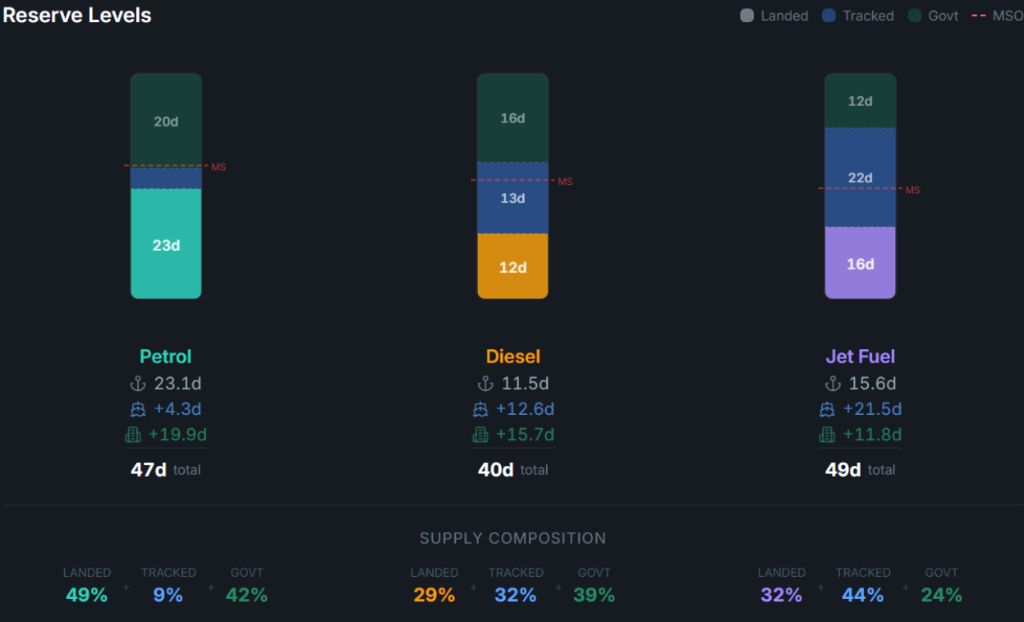
Chart of the Week: The Kiwi currency could crumble in an oil crisis
Our latest FX Tactical. In collaboration with
the Kiwibank Financial Markets team, we’ve updated our
outlook on the Kiwi dollar and key currency pairs. The
dramatic disruption and uncertainty surrounding the Middle
East conflict is creating immediate inflation pressures.
Despite geo-political uncertainty, the Kiwi dollar has yet
to crumble, but the path from here is defined by hope and
fear.
We started the year with rate hike expectations
already priced in. And such elevated expectations were
premature. But they persist. The dramatic disruption and
uncertainty surrounding the Middle East conflict is creating
immediate inflation pressures. In response, traders have
doubled down and factored in even more rate hikes, coming
earlier in 2026. But it is the demand destruction that’s
missing from interest rate market sentiment. We say it
again, rate market pricing is “way too aggressive and
premature."
It’s worth pointing out the illiquidity in Kiwi rates markets. Much of the move in wholesale rates has been flow driven. That means banks are facing the same way, needing to pay swap rates, and are unable to find receivers (typically hedge funds) on the other side. Hedge funds are conspicuously absent. Hence, rates have gapped higher.
It will take time, but the fundamentals will eventually override the squeeze. And rates should fall back in line with more rational expectations. The risks to domestic and global demand are heavily weighted to the downside. And the RBNZ understand the risks, all too well.
Our new RBNZ Governor, Anna Breman is encouraging us to keep ice in our bellies, and keep cool, calm and don’t overreact – at least that’s what the RBNZ will do. With wholesale rates pricing in three rate hikes this year (down from almost 4), we think the market has a long way to go. There’s money on the table for traders willing to watch the RBNZ pause until they assess the damage. And that will take time. The war needs to end, and oil prices need to normalise. Something that may take many months.
 Westpac New Zealand: Kiwi Households Adapting Despite Widespread Cost Pressure Concerns, Westpac Survey Shows
 University of Auckland: Kids’ Screen Use Linked To Long-Term Deficits In Self-Control And Attention
 University of Auckland: Research To Address Equity In STEM For Māori, Pacific And Female Students
 Stats NZ: Economic Impacts On New Zealand From Conflict In The Middle East – Report
 Advertising Standards Authority: ASA Annual Report 2025 - Platform-Neutral Regulation Keeps Pace With Digital Advertising
 Science Media Centre: Lead Pipes Banned For New Plumbing – Expert Reaction


