
 Scoop has an Ethical Paywall


A Fragile Ceasefire, A Volatile Market, And A Balanced Governor. Without Peace We Cannot Heal
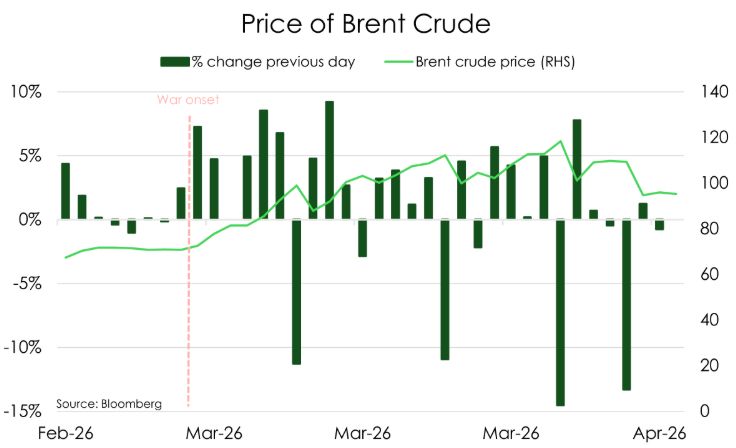
- Last Wednesday we were cautiously celebrating, after five weeks of the Middle East war, a cease-fire agreement was welcome news. But the re-opening of the Strait of Hormuz hasn’t eventuated. Oil tankers are still unable to flow through the Strait. And peace talks failed over the weekend. The ups and downs from the war continue to dominate the headlines, and financial market flows. So we’re back to where we started, with a bit of whip-lash to boot.
- Our view is that if this fragile step towards a peace treaty holds, oil flows, and the Kiwi economy can begin healing over the second half of the year. It’s an optimistic view. But even with oil flowing through the Strait again, it will take months to make up for 6 weeks of delays. And supply chains will be re-examined. There will be lasting impacts.
- We’re not out of the woods yet, and the next two weeks of ceasefire won’t bring swift relief. A much longer peace deal will need to hold for the Kiwi economy to stop feeling the pinch of fuel price increases and the threat of a diesel shortage.
Here’s our take on current events
Up to this point in the conflict, any news of de-escalation has been speculation only. To have a confirmed shift in the direction of a resolution was a huge (temporary) weight off.
Markets moved swiftly in response to the good news, with a sharp decline in the price of Brent Crude. We saw the price drop over US$7 per barrel in less than two hours. The NZD has also seen a boost, climbing 1c to $0.5806. And the Kiwi flyer was bolstered by what the market read as a Hawkish hold by the RBNZ (we disagree with this read, see our chart of the week for why).
We’re still waiting, hoping for this agreement to hold for the two-weeks and hopefully beyond. But news over the weekend reminds us not to count our chickens before they hatch. In the short term, not much will change for the Kiwi economy. If the cease-fire holds and negotiations re-commence, sentiment will improve as fear and uncertainty slowly dissipates. If not, we are likley to see uncertainty and elevated commodity prices squeeze the Kiwi economy into a contraction.
Even with oil flowing through the Strait again, we’ve lost five weeks (and counting) of oil supply from the Middle East. And oil tankers travel slowly, 10-15 knots, about the speed of a push-bike. Oil refineries are just now receiving the last shipments that left the region over five weeks ago. Now refineries will have to wait for the next shipments that have been severely delayed.
All that to say that we’re not out of the woods yet, and the next two weeks won’t bring swift relief. A much longer peace will need to hold for the Kiwi economy to stop feeling the pinch of fuel price increases and the threat of a diesel shortage.
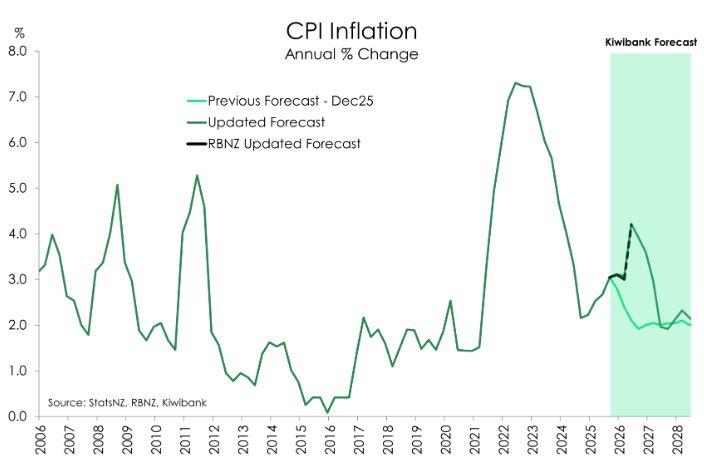
Chart of the Week: Beautifully weighted, evenly balanced. RBNZ not predicting future moves early
The RBNZ kept the cash rate steady at 2.25%, last Wednesday. The messaging was very clear and balanced. No hikes in the near term, because we need an end to the conflict. And we all need time to assess the damage. The medium-term risks are seemingly balanced, up and down, for the RBNZ. But we put a larger weight on the down(side).
The RBNZ managed to deliver a predictable and welcome hold “with full consensus”. With the 2.25% OCR staying put for the next six weeks, all eyes will be on the Middle East and the fuel crisis. Weighing up the pros and cons of any future moves, the RBNZ is showing both hawk and dove feathers. They don’t feel pressured to pick a move too early, and we agree.
We see little risk of inflation becoming imbedded in the economy through wages. This is largely due to the high unemployment rate, keeping downward pressure on wage growth. This is one of the key things the RBNZ will be keeping a close eye on in the coming weeks and months. If they see prices beginning to spiral up, they have warned that an increase in the OCR will likely follow.
 Bill Bennett: Fixed Voice Rules Head For Deregulation
 UN Department of Global Communications: United Nations Proposes New Global Dashboard To Measure Progress Beyond GDP
 Banking Ombudsman Scheme: Fraud Check Delays Well Worth The Inconvenience, Says Banking Ombudsman
 Asia Pacific AML: NZ’s Financial Crime Gap - Beyond The 'Number 8 Wire' Mentality
 Westpac New Zealand: Kiwi Households Adapting Despite Widespread Cost Pressure Concerns, Westpac Survey Shows
 University of Auckland: Kids’ Screen Use Linked To Long-Term Deficits In Self-Control And Attention


