
 Scoop has an Ethical Paywall


Could Northland's Marsden Point be NZ's first 'Special Economic Zone'?

Peter de Graaf, Northland reporter
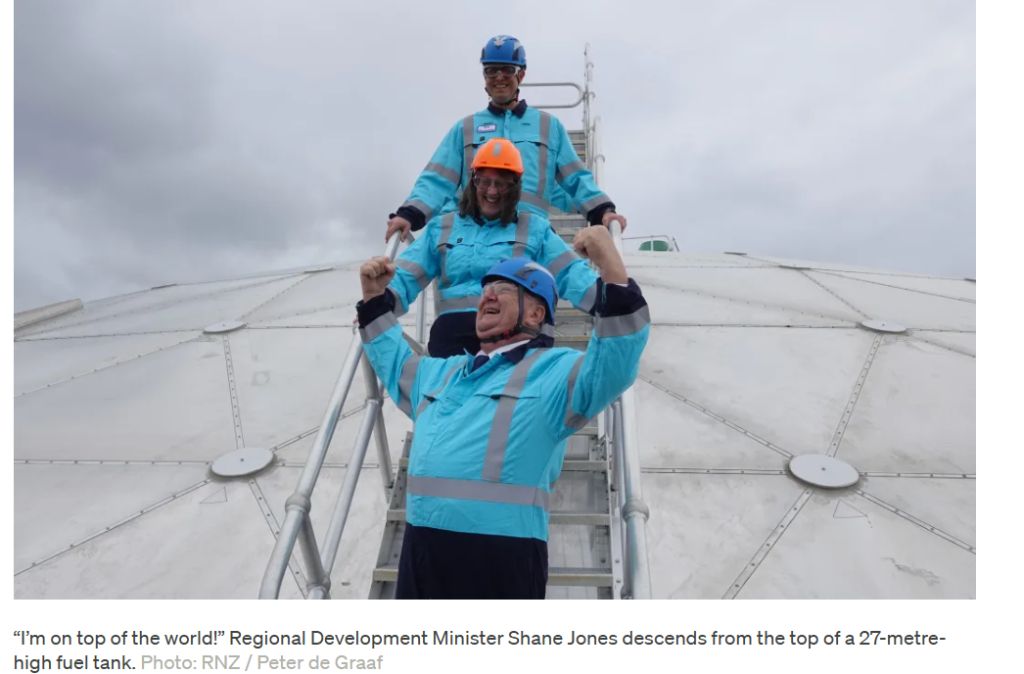
A 'Special Economic Zone' at Northland's Marsden Point could supercharge the region's - if not the country's - economy, Regional Development Minister Shane Jones says.
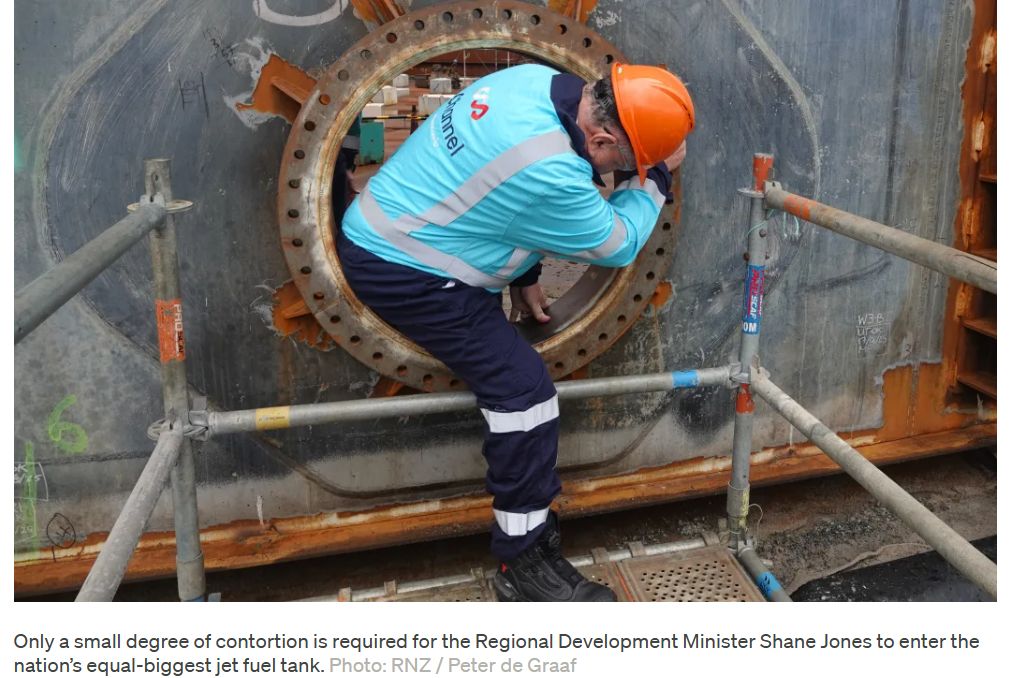
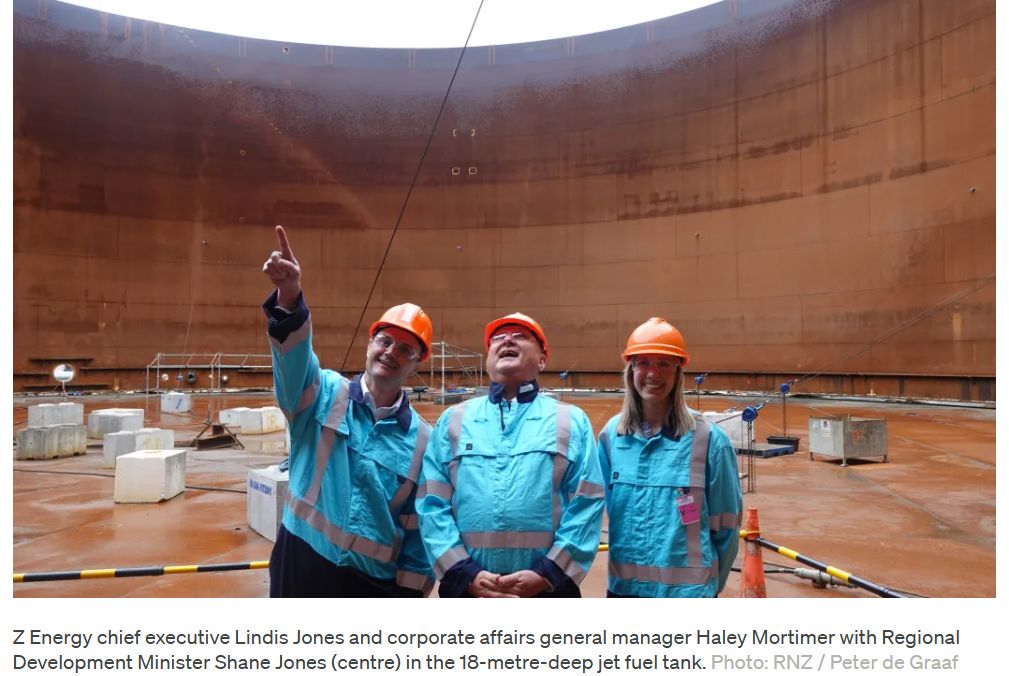
Jones and New Zealand First leader Winston Peters visited Marsden Point on Tuesday to inspect a jet fuel storage project, while also promoting their vision for encouraging investment around Northland's main port.
Peters said the area could "easily" become New Zealand's first Special Economic Zone.
It had New Zealand's best deep-water port, was closest to international shipping lanes, and had plenty of land to build on.
"These zones go a step beyond fast-track legislation. The zones will also have tax regimes that appeal to investors, local and international alike."
Jones said Special Economic Zones already operated in Ireland, Singapore and Croatia.
He said increased depreciation, tax "holidays" in which companies initially paid no tax, and attractive regulatory regimes could be used to attract large-scale investment in specific areas.
Jones admitted the plan was "unorthodox" and would not say if it was supported by the party's coalition partners - but he believed bold moves were needed because current efforts to grow the economy were not working.
"The Ruth Richardson bare austerity approach … it's not delivering the economic growth we need. Unless we have these kinds of bespoke initiatives, with tax incentives and self-consenting powers, I fear we're just going to be stuck in a rut talking about the same things year after year … and that's not good enough."
He said the party wanted to table Special Economic Zone legislation in the coming year, or take the policy to the next election.
Jones was typically provocative when describing how consenting in a Special Economic Zone might work.
"When the zone is created any conditions of an environmental resource management character should be written into the zone. And then, my view is, you just have a couple of engineers in a tin shed somewhere, they can quickly consent things. This business of constipating and protracting all these resource consent processes is making the country broke."
The Marsden Point zone, if created, could incorporate the former oil refinery site, the proposed Northport extension, and a planned dry dock facility for servicing large vessels such as Navy ships and Cook Strait ferries.
A rail link between the port and Northland's existing railway line was also vital for the development of Marsden Point, Jones said.
Meanwhile, the aviation fuel tank the ministers came to inspect was being constructed by Channel Infrastructure on the former Marsden Point oil refinery site.
Jones said it would boost New Zealand's resilience at a time of increasing geopolitical instability.
Channel chief executive Rob Buchanan said the 30-million-litre tank had previously been used for crude oil and was being adapted for jet fuel at cost of up to $30m, in partnership with Z Energy.
It would hold enough fuel for 10,000 flights between Auckland and Wellington.
Once complete it would increase total storage of jet fuel, petrol and diesel at Marsden Point to about 300 million litres.
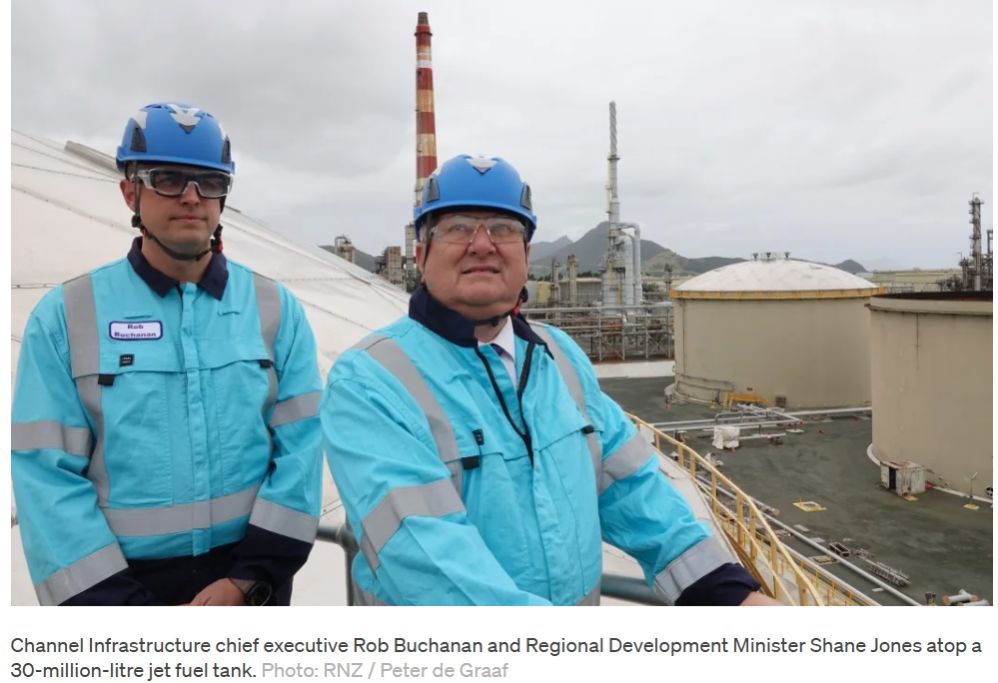
Buchanan said it was not the only project bringing life back to the site where oil refining ended in 2022.
"One of the projects we're working on very actively at the moment is repurposing the old refinery into a biorefinery, which could produce diesel and jet fuel. That's with some international partners because it would be a very significant amount of capital investment. It'd be really exciting to bring back manufacturing capacity," he said.
Buchanan would not say what would be used as the raw material, citing business confidentiality.
A decision as to whether the biorefinery would go ahead was expected next year.
Both Jones and Peters expressed disappointment at the oil refinery's closure, but with the cost of reopening it estimated at $5-7 billion, Jones accepted that was not going to happen.
"We're over that chapter and we have to support new industry and new investment," he said.
Peters said the Marsden Point rail project, which was part of the coalition agreement, was continuing to make progress.
Almost all the land required had been bought and KiwiRail had completed the design work.
The 19 kilometre rail spur between Oakleigh, south of Whangārei, and Northport had initially been estimated to cost $1 billion.
Peters said he would not accept such a high cost.
In the coming weeks KiwiRail would share its designs, on a confidential basis, with other potential builders, he said.
"We're going to get value for money. And if we don't get it from New Zealanders we'll get it from international competition. That's why I can guarantee you we're not talking about a billion dollars or anything like it."
Construction had originally been due to begin in late 2026 or early 2027 but Jones said that had been delayed.
The other major project planned for Marsden Point was a dry dock expected to cost $400-500m.
Jones said it would be a public-private partnership part-funded by the Regional Infrastructure Fund.
Shortlisted companies had until May to submit Requests for Proposal. Jones said the government was "getting closer" to choosing a successful bidder.
RNZ
New Zealand's public broadcaster, providing comprehensive NZ news and current affairs, specialist audio features and documentaries.
Radio New Zealand is a Crown entity established under the Radio New Zealand Act 1995. Radio New Zealand News are vital elements in our programming, providing impartial news and information to New Zealanders every day. Radio New Zealand (RNZ) provides listeners with exciting and independent radio programmes in accordance with the Radio New Zealand Charter.
 Gordon Campbell: On How US Courts Are Helping Donald Trump Steal The Mid-Terms
 Office of the Ombudsman: Ombudsman Publishes Findings On Ministry Of Education Sensitive Claims Scheme
 Nelson City Council: Mayor Welcomes Auditor-General Decision Not To Prosecute Councillor
 Johnnie Freeland: Ko Tātou Tātou - Climate Action In Aotearoa Begins With Relationship
 Zero Waste Network Aotearoa: Container Return Scheme Bill Would Double Recycling Rates And Put Money Back In Households
 Wellington City Council: Statement From The Wellington Mayoral Forum On Options For Regional Governance Reform
 MUNZ: TAIC Report On Kaitaki Incident Gives Shocking Picture Of Decline Of NZ Maritime Infrastructure

