
 Scoop has an Ethical Paywall


Government Gives Councils Amalgamation Ultimatum

Russell Palmer, Political Reporter
The government has given councils an ultimatum: come up with amalgamation plans within three months or the government will do it for you.
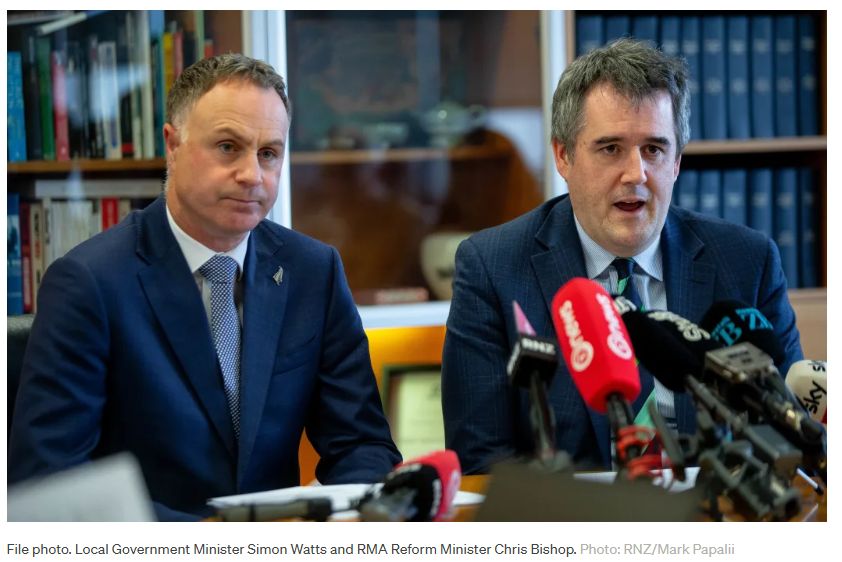
Local Government Minister Simon Watts and RMA Reform Minister Chris Bishop announced the move on Tuesday afternoon, giving a three-month deadline for reorganisation plans to be delivered.
It followed an announcement in November that groups of city and district mayors - with some government oversight - would be formed to come up with such plans.
But the ministers on Tuesday appeared to do away with that approach, saying if councils failed to make use of the new 'Head Start' approach, they would be forced into changes.
Instead, councils would form voluntary groups, and bring their ideas for those to the government about how they wanted to reorganise.
"Our message to councils is simple: lead your own reform, or we will do it for you. Either way, change is coming," Bishop said.
Watts was explicit that proposals should focus on creating "larger, more efficient unitary authorities that streamline functions, reduce duplication, and improve decision-making".
He said ministers did not have a specific number of councils they wanted to end up with, and it would depend on the plans they received - and the process would provide councils with "real flexibility".
"Proposals don't need to cover an entire region, but they must show clear support, strong leadership, and real benefits for communities."
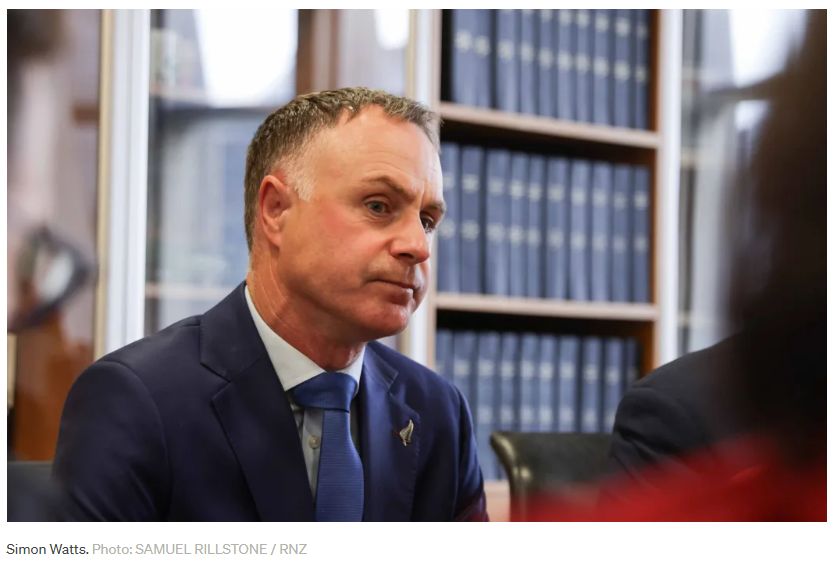
The proposals would be considered by officials from the new Cities, Environment, Regions and Transport mega-ministry (MCERT) against criteria including practicality, simplicity, value for money, effective representation, timeliness and how it works with the new resource management system.
Bishop urged the councils not to hire "hordes of expensive consultants" to work up the plans, and indicated the Commerce Commission would eventually have responsibility for ensuring rates provided value for money.
Decisions would be made this year, then developed in detail and signed off in 2027 to be implemented ahead of the 2028 local elections.
"Put it this way, regional councillors will not be elected at the 2028 local body elections."
Watts said for areas that failed to come forward with plans within the three months, the government "will implement a backstop process to ensure reform still happens across the country".
"This will involve a standardised approach, including transitional governance arrangements while changes are put in place," Watts said.
They said the government was still working out what the backstop would look like, but it would likely resemble the Combined Territories Board approach announced in November.
New Zealand's local government system currently has 78 councils of three kinds:
- Regional councils, covering large areas based largely on water catchments and with responsibility for environmental management, civil defence and flood protection
- City and District councils, which are based on metropolitan areas and have responsibility for local infrastructure like roads, and services like waste collection, pools and libraries
- Unitary authorities, which combine the responsibilities of the two, like in the Auckland supercity, Nelson, Gisborne, Tasman, Marlborough and the Chatham Islands
Bishop said about 1150 groups and individuals - including 70 from councils, as well as sector groups, iwi, and the public - provided feedback after the November announcement, with "strong support for change".
"I expected kind of all hell to break loose and everyone to go bananas, and actually what's happened is the opposite, is people have gone 'oh, fantastic, you guys are up for change, so are we', and they just started getting on with it.
"But many councils want more flexibility to get on with reform in a way that works for their region. Several mayors have told us they're ready to move now, with clear ideas about what should change and how to do it."
He said the government had considered delaying local government reform until after the RMA reforms, but came to the view the two "simply must go hand in hand".
"Fixing the planning system whilst leaving local government untouched would just lock in many of the same problems that have bedevilled our current system for too long."
Bishop said the previous approach of setting up Combined Territories Boards received mixed feedback, with some saying mayors were busy enough running their own councils.
He said other options were to live with the status quo, or to set up a "massive" royal commission that would take a long time and be very expensive - and end up with the same solution anyway.
He confirmed some groupings were already looking at moving forward with amalgamation including:
- Northland
- Waikato
- Bay of Plenty
- Wellington
- Wairarapa
- Hawke's Bay
He also indicated the government would make "quite a significant investment in the digital backend" for council planning as part of the new resource management system.
"For the first time we will have a national map of natural hazards and flood-prone areas in one nationally accessible portal by everybody. These are transformational changes - they're not easy by the way, and they're quite expensive, and they're not going to happen tomorrow, but over the next two to three, four years the landscape about how we do planning in this country and infrastructure and housing investment is going to change."
Bishop dismissed questions over whether three months would be enough time.
"They can meet the three-month timeframe, honestly local government spends its life consulting people ... they can. They can ... three months is more than enough time."
He acknowledged not every mayor would have been given a heads up, but "quite a few have, as have quite a few other people to be honest", including several iwi.
Labour's local government spokesperson Tangi Utikere said the approach was "messy" and "watered down".
"While it's positive that councils have been consulted on their own reform, we'll see more twists and turns for the government to blame missteps on councils and further excuses for overreach. The government should fund councils to properly deliver the services they require.
"Stuck in their own echo chamber, it's disappointing the government don't see the most significant form of Local Government reform since 1989 as something to engage with Labour over."
RNZ
New Zealand's public broadcaster, providing comprehensive NZ news and current affairs, specialist audio features and documentaries.
Radio New Zealand is a Crown entity established under the Radio New Zealand Act 1995. Radio New Zealand News are vital elements in our programming, providing impartial news and information to New Zealanders every day. Radio New Zealand (RNZ) provides listeners with exciting and independent radio programmes in accordance with the Radio New Zealand Charter.
 Gordon Campbell: On The Risks Of AI In The Workplace
 PSA: Councils Must Work With Unions And Communities In Fast-Track Reform
 Tauranga City Council: Mauao Restoration Work Has Begun
 Horizon Research: New Poll Finds High Concern About Fuel Situation
 Tiaki Wai: Over 1,150 People Give Feedback On Tiaki Wai Water Services Strategy
 Greenpeace Aotearoa: Israeli Forces Illegally Attack Peaceful Humanitarian Flotilla
 Zero Waste Network: Container Return Scheme Bill Could Save Councils $50m A Year And Put Money Back In Households

