
 Scoop has an Ethical Paywall


Deep In The Forest A Long, Piercing Shriek Is Sliding Into Silence
Work is underway to address the decline of a unique parasite
A conservation puzzle involving an endangered shrieking bird, long-range international travel, and some reluctant adoptive parents made its way into the forests of inland Hawke’s Bay recently.
Scientists from the Bioeconomy Science Institute travelled to the Forest Lifeforce Restoration Trust’s property in the Maungataniwha Native Forest, bordering Te Urewera, to catch and tag specimens of the endangered Long-tailed cuckoo (koekoeā) to help find out why their numbers are declining.
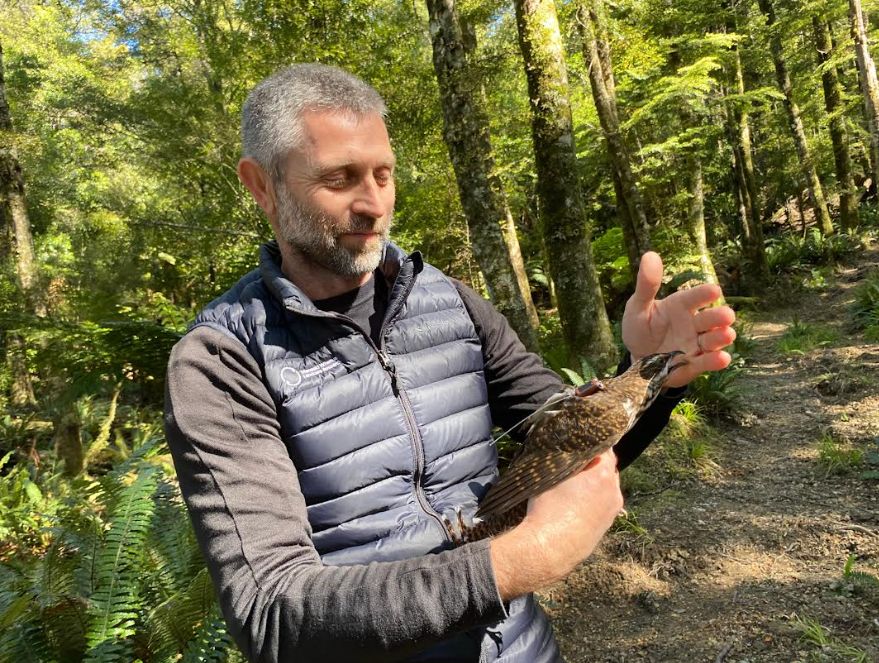
Koekoeā are brood parasites now classed as a nationally vulnerable threatened species. They lay their eggs in other birds’ nests, almost exclusively in those of three closely related endemic forest birds - pōpokotea (whitehead) in the North Island, and mohua (yellowhead) and pīpipi (brown creeper) in the South Island.
These host birds are vulnerable to predation by introduced mammalian predators like ship rats and stoats. Decline of the hosts is followed by decline and local extinction of koekoeā populations. But the puzzle is that when new populations of the hosts have been established elsewhere, the koekoeā have not followed.
The Bioeconomy Science Institute is working with the Department of Conservation to better understand why.
Catching at Maungataniwha was led by Neil Fitzgerald, a conservation ecology researcher at Bioeconomy Science Institute. Maungataniwha Native Forest benefits from significant pest and predator control work undertaken by the Forest Lifeforce Restoration Trust and has been able to maintain a significant population of koekoeā.
The team used mist nets, long swathes of fine netting that are invisible to birds in flight, to catch seven koekoeā. They drew blood samples from each of these and attached small tracking tags to five of them. The tagged birds are still moving around the general area they were caught, and the particularly interesting data, where they migrate to, will hopefully start to come in autumn.
Koekoeā are a unique and distinctive part of New Zealand’s birdlife that travel up to 6,000km each year, to islands scattered across a vast 11,000 km-wide arc of the Pacific. They return to New Zealand around September or October to breed. Their presence, heralded by their piercing drawn-out shriek, has long been a sign of the arrival of spring.
The koekoeā are thought to return to their place of birth. Understanding why they are not following their host birds, and how to change this, is crucial for their conservation, Mr Fitzgerald said.
“Our research will track koekoeā to better understand their movement within New Zealand, and on migration. We will also use genomics tools to estimate the current population size and gene flow between remaining koekoeā populations across the country,” he said.
“With a cryptic and highly specialised species like koekoeā, there is a real risk that conservation work could be much more difficult and expensive, or even come too late, if we don’t understand what these birds need.”
Mr Fitzgerald said there was an opportunity for the public to help with this research.
“Unfortunately, koekoeā are often killed or injured by flying into windows. Even these dead birds can make an important contribution to our work so we’re asking anyone who finds a freshly dead koekoeā to please put it in a plastic bag, freeze it, and contact me by email at FitzgeraldN@landcareresearch.co.nz.”
Anyone finding an injured koekoeā should phone 0800 DOC HOT (0800 362 468) or contact the nearest DOC office or native bird rescue, and then contact Mr Fitzgerald.
About the Forest Lifeforce Restoration Trust
The Forest Lifeforce Restoration Trust was established in 2006 to provide direction and funding for the restoration of threatened species of fauna and flora, and to restore the ngahere mauri (forest lifeforce) in native forests on three properties in the central North Island, one in the South Island’s Fiordland National Park, and one on Stewart Island.
It runs eight main regeneration and restoration projects, involving native New Zealand flora and fauna. These include a drive to increase the extremely rare wild-grown population of the kākābeak shrub (ngutukākā / Clianthus maximus), and the re-establishment of native plants and forest on 4,000 hectares currently, or until recently, under pine.
The Trust has also established a name for itself as one of the most prolific and successful kiwi conservation initiatives in the country.
 Gordon Campbell: On The Political Panic Over Immigration
 Internal Affairs: Citizenship Test For Citizenship By Grant Applicants From Late 2027
 Dayenu: Condemning Use Of Government Funding For Extremist Report On Antisemitism
 PSA: Councils Must Work With Unions And Communities In Fast-Track Reform
 Tauranga City Council: Mauao Restoration Work Has Begun
 Horizon Research: New Poll Finds High Concern About Fuel Situation
 Tiaki Wai: Over 1,150 People Give Feedback On Tiaki Wai Water Services Strategy


