
 Scoop has an Ethical Paywall


Regional Moorings and Marinas Strategy finalised
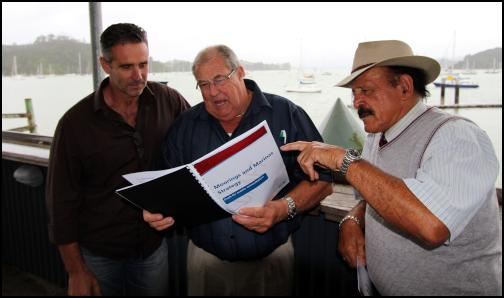
Northland Regional Council members David Sinclair, left, Craig Brown, centre, and the Honourable Dover Samuels, at Opua during the April hearings of public submissions on the council’s Moorings and Marinas Strategy.
Date: 15 August, 2014
Regional Moorings and Marinas Strategy finalised
A new strategy designed to give more certainty about the way moorings and marinas will be managed in Northland over the next 20 years has been signed off by Northland Regional Council members.
Growing pressure on limited mooring and marina space around Northland’s coast – especially in the Bay of Islands – prompted the regional council to last year release a Draft Mooring and Marinas Strategy for public feedback.
The strategy was developed over 18 months after consultation with a variety of key stakeholders including local residents, boating clubs, tangata whenua, commercial and environmental interests, other local authorities, contractors and marina developers.
More than 140 people and organisations submitted on the strategy, which aims to address management issues around how and where boats can be moored in Northland, with public hearings subsequently held at Opua in April.
The three-member hearings committee was chaired by councillor Craig Brown, who represents the council’s Coastal South constituency, assisted by Coastal North constituency representative the Honourable Dover Samuels and Whangarei Urban constituency representative David Sinclair.
Councillor Brown says the committee members had appreciated the considerable time and effort people had put into their submissions and the quality and detail of the information they had provided.
“This proved invaluable to the committee when we were deliberating and influenced our recommended changes to the proposed strategy, which the full council has recently confirmed.”
Councillor Brown says the main changes in the final version are:
• A requirement for would-be marina developers to pay mooring holders market value for their moorings if these could not be relocated
• A 25 percent reduction in the size of proposed new mooring areas in Opua
• Cutting the strategy’s focus from 50 years to 20
• An increased focus on environmental impacts from moorings and marinas.
He says the council will now roll out a number of operational initiatives stemming from the strategy, including trialling some new mooring technologies.
“However, most of the strategy’s key points will be largely implemented through council’s new Regional Coastal Plan, which we expect to begin drafting early next year.”
Councillor Brown says the Regional Coastal Plan is the overarching legal planning tool for managing the use of Northland’s coast and as well as moorings and marinas, covers a large range of other activities.
“These include management of structures like wharves and boat ramps, reclamations, discharges, dredging and aquaculture.”
Councillor Brown says the public will have many opportunities to comment on these matters as the new Regional Coastal Plan is developed over the next several years.
Meanwhile, he says the finalised Moorings and Marinas Strategy can be viewed on the regional council’s website via: www.nrc.govt.nz/mmstrategy
 Gordon Campbell: On How US Courts Are Helping Donald Trump Steal The Mid-Terms
 Forest And Bird: Government Biodiversity Credit Scheme Welcomed As Opportunity For Restoration
 Office of the Ombudsman: Ombudsman Publishes Findings On Ministry Of Education Sensitive Claims Scheme
 Nelson City Council: Mayor Welcomes Auditor-General Decision Not To Prosecute Councillor
 Johnnie Freeland: Ko Tātou Tātou - Climate Action In Aotearoa Begins With Relationship
 Zero Waste Network Aotearoa: Container Return Scheme Bill Would Double Recycling Rates And Put Money Back In Households
 Wellington City Council: Statement From The Wellington Mayoral Forum On Options For Regional Governance Reform


