
 Scoop has an Ethical Paywall


SMC Heads-Up: Climate consensus, Budget, mental disorders

SMC Heads-Up: Climate consensus, Budget 2013, and redefining mental disorders
Issue 231
17 - 23 May
2013
Quick Links
Media Registration
More About Us
Contact Us
Climate
consensus measured
A
team of citizen scientists backed by the University of
Queensland have analysed 20 years of peer-reviewed
literature on climate change, showing 97 per cent of papers
endorse the position that humans are contributing to climate
change.
The research, published in Environmental research Letters, is part of the Consensus Project, headed by Queensland University researcher and Skeptical Science founder John Cook. The project was designed to illustrate with evidence the consensus in the scientific community on human-induced climate change.
"This underscores the importance of correcting the mis-perception that scientists are still debating whether humans are causing global warming," said Cook in a comment piece on the research.
"An important step towards stronger public support for meaningful climate action is closing the consensus gap."
Of the 4,014 abstracts authored by 10,188 scientists that stated a position on human-caused global warming, 97.1% of the abstracts endorsed the consensus while 98.4% of the authors endorsed the consensus.
The science communication project builds
on the work of author and climate researcher Naomi Oreskes
who surveyed 928 papers published between 1993 and 2003
whose abstracts matched the search term "global climate
change". She found zero papers rejecting the consensus
position that humans are causing global
warming.
On the science radar this week...
NASA Kepler break down, billion-year-old water life, solar flare-up, flexing your political muscle (literally) and
electrical arithmetic boosters .
Detail slight on R&D tax
deductions
While
science received a modest top-up in the Budget this year,
with a net increase of $50 million allocated to science and
innovation initiatives, an intriguing tax provision aimed at
helping start-ups engaged in R&D is potentially
significant.
The scheme would allow small companies engaged in research and development to claim tax losses on that activity. Presumably it means that, for instance, software companies spending the first years of their existence as loss-making entities while they develop their products, could claim tax back against the amount of spending they do on researching and developing their software products.
You might be thinking that loss-making New Zealand companies don't pay any tax anyway - and you'd be right. As IRD explains:
"If a company's total expenses exceed its total income, it will generally have a loss for tax purposes. Companies in a loss position do not have to pay income tax."
So how will the tax break work - tax losses brought forward or converted to cash payments? No detail has been released about the scheme. But key questions will include:
- How is research and
development defined?
- Will there be a limit on the
amount that can be claimed in any one year or over
successive years?
- Will IRD basically write a cheque to
the start-up annually based on the taxed amount of the R&D
it has done?
The UK's tax relief scheme for R&D allows small and medium sized companies engaged in R&D to claim tax relief on revenue expenditure:
"Generally, this means costs incurred in the day-to-day running of the business - not capital expenditure on assets."
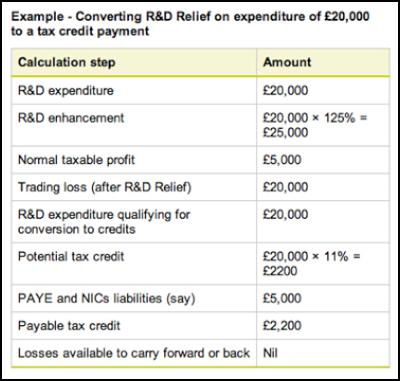
In the UK, R&D-related tax expenses, under certain circumstances, could be carried forward as tax loses or converted to tax credits as the below scenario illustrates:
Other costs eligible for tax relief in the UK scheme include employee salaries, contractor fees, materials, software and even fees paid to participants in clinical trials.
Revenue Minister Peter Dunne said in a statement that the scheme would encourage early-stage companies to spend more on R&D.
"That expenditure can be crippling for small ventures, given their capital constraints. With this proposal, we are effectively recognising that and looking to make sure these small companies are not disadvantaged".
Details of the proposed scheme will be released next month with a period of public consultation to follow. The SMC was unable to obtain further detail on the tax provision from Peter Dunne's office by press time.
Over-diagnosis concern for 'bible'
The latest edition of the manual
defining criteria for mental illness is set to have a major
impact on how patients are diagnosed and how their treatment
is funded.
Often called the
'psychiatric bible', the Diagnostic and Statistical Manual of Mental
Disorders (DSM) is published by the
American Psychiatric Association (APA) and contains
descriptions, symptoms, and other criteria for diagnosing
mental disorders.
The Manual's fifth edition, DSM-5, is to be launched at a press briefing at the APA conference in San Francisco this Sunday (NZT).
Some of of the proposed changes likely to be included in the new DSM -- which hasn't been updated since 2000 -- have gathered considerable criticism from both experts and the public. Controversial proposed changes include:
- Re-classifying Asperger's
Syndrome under the broader Autism Spectrum Disorder
diagnosis.
- Removal of certain exclusion criteria
separating bereavement grief and depression.
- A broader
definition of attention deficit hyperactivity disorder
(ADHD)
- A reshuffle of diagnostic criteria for post
traumatic stress disorder (PTSD).
An open letter criticising some
of the DSM-5 revisions has gathered more that 14,000
signatures.
Ahead of Sunday's launch of the DSM-5, the
SMC contacted New Zealand experts for comment on the new
edition and its implications for NZ.
Mr Peter
Coleman, President of the NZ Psychological Society,
said:
"The fact that the DSM-5 has lowered the
threshold for some diagnoses and added a number of
additional diagnoses raises the risk of giving a mental
health diagnosis to someone who may simply be experiencing
normal problems of living."
Assoc Prof David
Menkes, from the department of Psychological Medicine,
University of Auckland,
commented:
"There are both
benefits and harms that can come from use of a
classification system, and DSM-5 is no exception. It's
important to keep the benefits in mind but also to be fair
and honest in the criticism of such systems. With regard to
DSM-5, the main criticisms are likely to centre on
'over-diagnosis', the process by which medical diagnoses are
applied inappropriately and/or harmfully."
You can
read more about the DSM-5 revisions and further commentary
on the SMC website. An AusSMC background
briefing is available for playback here.
Quoted: New York Times
"Life comes with many challenges. The ones that
should not scare us are the ones we can take on and take
control of."
Angelina Jolie on
her double mastectomy after learning she carried the cancer-associated BRCA1 gene
variant.
Vacuum investor puts up the
cash
British industrial designer Sir James Dyson is
challenging young engineers and scientists in New Zealand
and 17 other countries around the world to 'design something
that solves a problem.'The James Dyson Award provides an
opportunity for an emerging New Zealand product designer to
travel to the United Kingdom to check out the British design
scene, network and mingle with inspiring inventors and
designers.
You can read more about the 2013 Award here.
Last year, New Zealand industrial designer James McNab was the international runner up with his design, Revival Vest, a safety vest worn by free fall divers.
Entrants have until 1st August
2013 to enter by submitting prototypes along with stories
detailing their design process and inspiration.
SAVVY workshop for
Wellington
Applications are open for the Science Media
SAVVY media training programme Wellington this June - don't
miss out!
Science Media SAVVY is a two-day course designed to give scientists and researchers the confidence and skills they need to engage effectively with the wider public through broadcast, print and social media.
Participants gain practical techniques to improve their communication, deal with nerves, adapt their message to their audience, capture attention, influence headlines, and respond effectively when an interview becomes challenging.
The
Wellington workshop will be held at the Royal Society
buildings on the 20-22, June.
Find out how to apply
here.
You can read more about the workshop and what past participants have to say about it here.
Help us spread the word by downloading an information flyer (PDF) and highlighting this opportunity to colleagues and peers.
New from the SMC
Experts Respond:
Stem cells:
Coronavirus: Experts
comment on the latest WHO announcement regarding the
emerging novel corona
virus.
IFV success: Research reveals IVF technology that proponents claim will significantly increase live birth rates in fertility clinics.
DSM-5:
Experts comment ahead of the international launch of
new edition of the guide for
diagnosing mental disorders.
In the News:
Kiwi genetics: A study on the the genetic diversity of the little spotted kiwi suggests all modern members of the species descended from five kiwis rescued in 1912.
Te Papa backlash: Scientists are far from happy regarding cutbacks and restructuring at NZ's national museum, reports Campbell Live.
Restarting the debate? An article in The Atlantic reflects on the social and ethic ramifications of recent stem cell research.
Budget 2013: Read commentary and a rundown of science related changes from this weeks Budget 2013 release.
Sciblogs highlights
Some of the highlights from this week's posts:
Will Lord Winston's medicinal labelling bill
get off the ground? The famed scientist is
pushing for medicines that have utilised animal testing in
their development to be labelled as such, reports Peter
Griffin.
Griffins Gadgets
New Zealanders - opportunity to learn how
our immune systems work - Grant Jacobs
highlights Nobel Laureate Peter Doherty's NZ speaking
tour.
Code for Life
The 10 most WANTED - New Zealand's
conservation wishlist - Wayne Linklater and his
colleagues have been hammering out some pest control
priorities.
PolitEcol Science
Research highlights
Please note: hyperlinks point, where possible, to the relevant abstract or paper.
Auditing cardiac
care: A 'snapshot' audit of acute cardiac care in
Australia and New Zealand has found pockets of excellence,
but also alarming variations in terms of patient care.
Researcher tracked 4,350 Acute Coronary Syndrome patients
over two weeks, covering 470 hospitals across Australia and
New Zealand. The results of the study identified substantial
variation in the quality of care, especially for patients
suffering other conditions simultaneously. Climate consensus (yet again):
Glaciers and sea level rise: Getting artificial skin to
feel: Saving
fertility in chemotherapy:
Medical Journal of
Australia
Environmental Research
Letters
Science
Nature Communications
Science Translational
Medicine
Policy
updates
Some of the policy highlights from this week:
Psa Plan: A national management plan for
dealing with the kiwifruit Psa virus has been formally
approved by Ministry for Primary Industries.
Laser limits:
Hand-held lasers strong enough to be a hazard to
aircraft will be subject to new import, sale and supply
controls under Health and Customs legislation,
according to the Ministry of Health.
Stated Intentions: The office of the Parliamentary Commissioner for the Environment has released an official Statement of Intent, as has the Ministry of Business Innovation and Employment and Ministry of Health.
Upcoming sci-tech events
• The Killer Defence - Nobel
Laureate Prof Peter Doherty - 21 May, Wellington.
• "At best a neutralitie" - how might we
measure well-being? - Prof Rob McGee, Inaugural
Professorial Lecture - 21 May, Dunedin.
• Science Communicator's photography
masterclass - led by experienced science
photographer Gerry Le Roux, May 21, Wellington.
For
these and more upcoming events, and more details about them,
visit the SMC's Events Calendar.
ENDS
Science Media Centre NZ

Our aim is to promote accurate, evidence-based reporting on science and technology by helping the media work more closely with the scientific community.
The Science Media Centre is New Zealand's only trusted, independent source of information for the media on all issues related to science. Thousands of news stories providing context from and quoting New Zealand researchers have been published as a direct result of our work.
 University of Auckland: Junk Food Designed To Make Us Eat More, Study Finds
 Spark: New Report Sets Out Outcomes-Led Approach To Lift Rural Connectivity Using The Right Mix Of Technologies
 Bill Bennett: Fixed Voice Rules Head For Deregulation
 UN Department of Global Communications: United Nations Proposes New Global Dashboard To Measure Progress Beyond GDP
 Banking Ombudsman Scheme: Fraud Check Delays Well Worth The Inconvenience, Says Banking Ombudsman
 Asia Pacific AML: NZ’s Financial Crime Gap - Beyond The 'Number 8 Wire' Mentality


